Polyuse (Head office: Minato-ku, Tokyo; Representative Directors: Takuya Iwamoto / Wataru Ooka), a Japanese manufacturer of construction 3D printers with the largest number of construction cases in Japan (*1), is pleased to announce that it has signed a joint research agreement with Fudo Tetra Corporation (Head office: Chuo City, Tokyo; President and Representative Director: Shinya Okuda), which focuses on wave-dissipating and toe-protection blocks, typified by the "Tetrapod," and also offers formwork rental and environmental and landscape products. As a preliminary verification, the two companies have already succeeded in producing a printed object equivalent to a 0.5-ton Tetrapod using a construction 3D printer. Going forward, they will evaluate its performance in the marine environment and verify the effectiveness of its environmental symbiosis functions, aiming not only to reduce labor in construction but also to increase CO2 absorption and fixation by promoting the attachment of seaweed. (*1) According to research by the Japan Society of Civil Engineers
- Overview and background
3D printing technology has advanced remarkably in recent years, and its applicability is being explored in many fields. Development of construction 3D printers has been led by overseas players, mainly in Europe and the United States, but several companies in Japan are also developing construction 3D printers. The construction industry has long warned of a shortage of workers, and the shortage of formwork workers who produce concrete products is particularly severe: as of 2012, workers aged 45 and over made up more than 60% of the workforce (Source: Japan Formwork Contractors Association). In addition to construction sites, manufacturers of precast secondary products are also increasingly calling for labor savings. With overtime regulations set to apply to the construction industry from April 2024, the environment will become even more challenging, and we recognize that the need for digital construction will only grow.
Polyuse's construction 3D printers are the most widely used in Japan's construction 3D printer market and have the largest number of construction cases. Together with contractors and manufacturers of precast secondary products nationwide, Polyuse plans to carry out construction in nearly every region of Japan within this fiscal year. Going forward, to help maintain the balance between demand at construction sites and the supply of skilled workers across the country, we aim to expand the range of structures that can be built with construction 3D printers and to develop new uses for printed structures.
Fudo Tetra, for its part, is promoting DX and ICT in its concrete block business to reform work styles and improve productivity, and is also addressing environmental issues such as promoting the use of low-carbon materials and increasing the attachment of seaweed, which serves as blue carbon. To achieve these goals, it had long been exploring the potential of construction 3D printers.
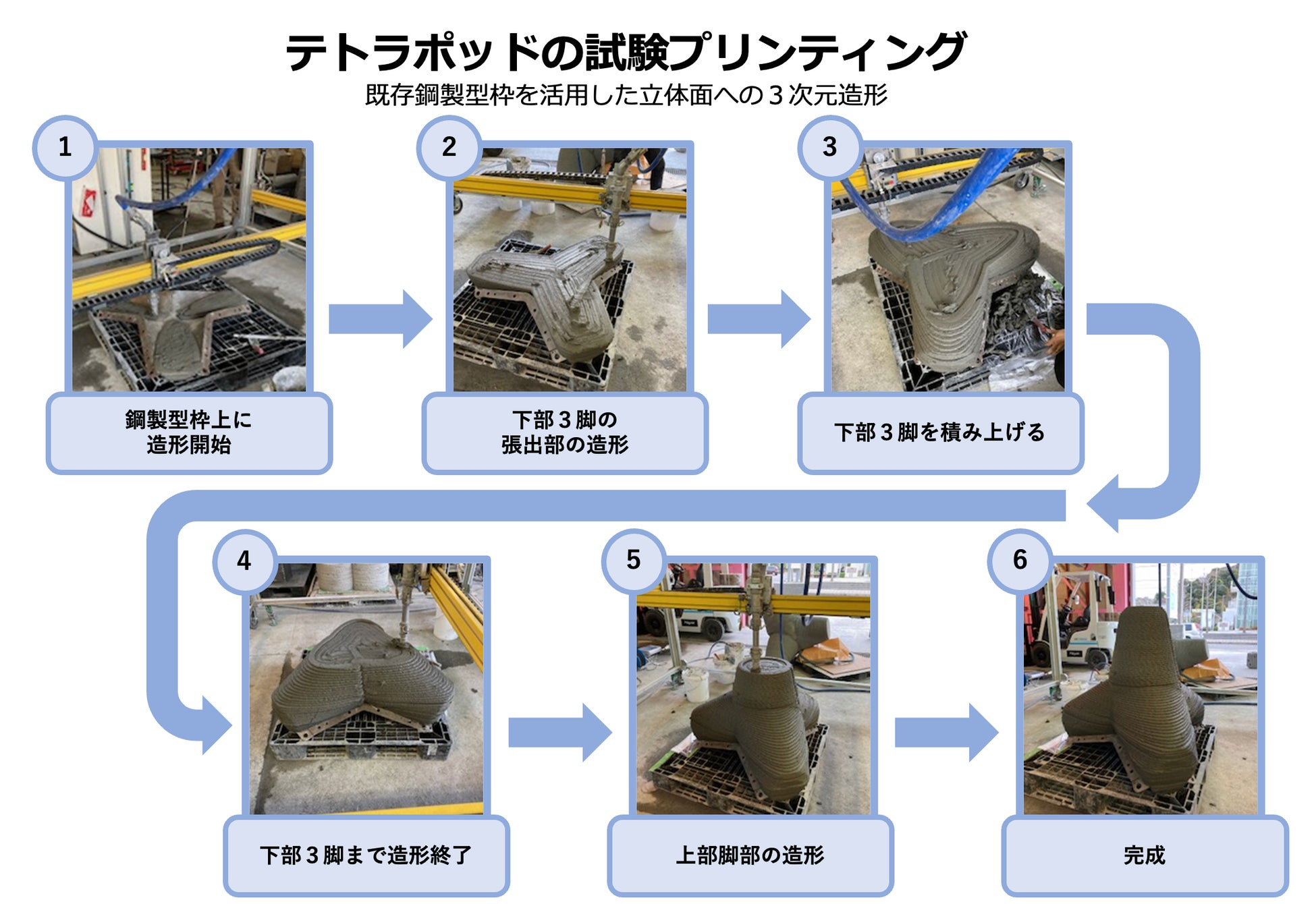
With the aim of researching a variety of uses and new products made possible by construction 3D printers through joint R&D, Fudo Tetra and Polyuse have begun joint research, and as their first joint initiative, printed a 0.5-ton Tetrapod-type object with a construction 3D printer.
- Results of printing a 0.5-ton Tetrapod-type object with a construction 3D printer
For this Tetrapod, conventional formwork was set in place and the printing was carried out on top of it to form the Tetrapod.
Using this printing method, we were able to experimentally verify, in parallel, that printing on non-smooth surfaces is possible and the potential of shape-generation methods that make use of steel formwork.
- Expected outcomes of using construction 3D printers for wave-dissipating and toe-protection blocks
3D printers can produce complex shapes without formwork. Although various challenges remain, they are highly likely to be applicable to concrete blocks, and if these challenges are solved and the technology is put to practical use, it is expected to enable uses different from the current formwork-based production methods. In this joint research, we expect the following benefits from producing structures with construction 3D printers.
●Reduced CO2 emissions and increased CO2 absorption and fixation over the period from block production through several decades after installation on site
●In the production of concrete blocks for the formwork rental business, many processes rely on workers' experience and intuition, making mechanization difficult; the application of ICT construction is expected to enable mechanization, labor savings and greater efficiency
- Next steps in the joint research
In addition to printing the 0.5-ton Tetrapod-type object with a construction 3D printer, the following two main activities are planned.
(1) Material testing of mortar for construction 3D printers
Various material tests are planned to confirm the long-term durability in the marine environment of hardened mortar for construction 3D printers, which is printed in layers, a characteristic of the construction 3D printer printing method.
This research is being carried out as a joint research initiative with the Port and Airport Research Institute of the National Institute of Maritime, Port and Aviation Technology, under a signed agreement.
(2) Verification testing of the environmental symbiosis functions of mortar specimens for construction 3D printers
As expectations grow for blue carbon in marine structures, verification tests of environmental symbiosis functions are planned in actual sea areas using mortar specimens printed with a construction 3D printer, mainly to confirm their effect in promoting the attachment of seaweed.
- What is a construction 3D printer?
A construction 3D printer is a specialized 3D printer used to construct buildings and structures. Compared with conventional construction methods, it can produce concrete structures more quickly and efficiently, and is expected to streamline the construction process and improve building quality. It is also expected to reduce labor requirements and improve safety at construction sites, and further promotes environmental considerations such as the use of sustainable building materials and the reduction of waste.
Today, construction 3D printers are moving from the experimental stage to full-scale practical use in many countries, including Japan. Numerous countries and companies are working on the development and research of construction 3D printers, and the technology is considered likely to become widespread as one that will bring innovation to the building industry in the future.
▶A pioneer of 3D-printed construction! Even an ambassador comes to see "Japan's first"!
▶Polyuse selected as one of the "100 Startups Updating Architecture"
https://xtech.nikkei.com/atcl/nxt/mag/na/18/00178/
▶Polyuse wins the "Excellence Award" at MLIT's FY2022 Infrastructure DX Awards
https://prtimes.jp/main/html/rd/p/000000019.000049711.html
▶Selected as a J-Startup company by METI
https://www.meti.go.jp/press/2023/04/20230406003/20230406003.html
▶Taking on the "printing" of reinforced concrete: Polyuse leads the way with 3D printers
https://xtech.nikkei.com/atcl/nxt/mag/ncr/18/00196/091200002/
- About Polyuse Inc.
Company name: Polyuse Inc.
Location: 2-2-15 Hamamatsucho, Minato-ku, Tokyo (development base in Kanagawa Prefecture)
Representative Directors: Takuya Iwamoto / Wataru Ooka
Business: Planning, design, manufacturing and sales of hardware, software and services specialized for the construction industry, centered on construction 3D printers
Founded: June 2019
URL: https://polyuse.xyz/
- About Fudo Tetra Corporation
Company name: Fudo Tetra Corporation
Location: Pentel Building, 7-2 Nihonbashi Koami-cho, Chuo City, Tokyo
President and Representative Director: Shinya Okuda
Business: Civil engineering, ground improvement and block businesses
Founded: January 1947
[Media inquiries regarding this release]
Please direct inquiries about construction 3D printers to:
Polyuse Inc. Public Relations Department
Email: info@polyuse.xyz