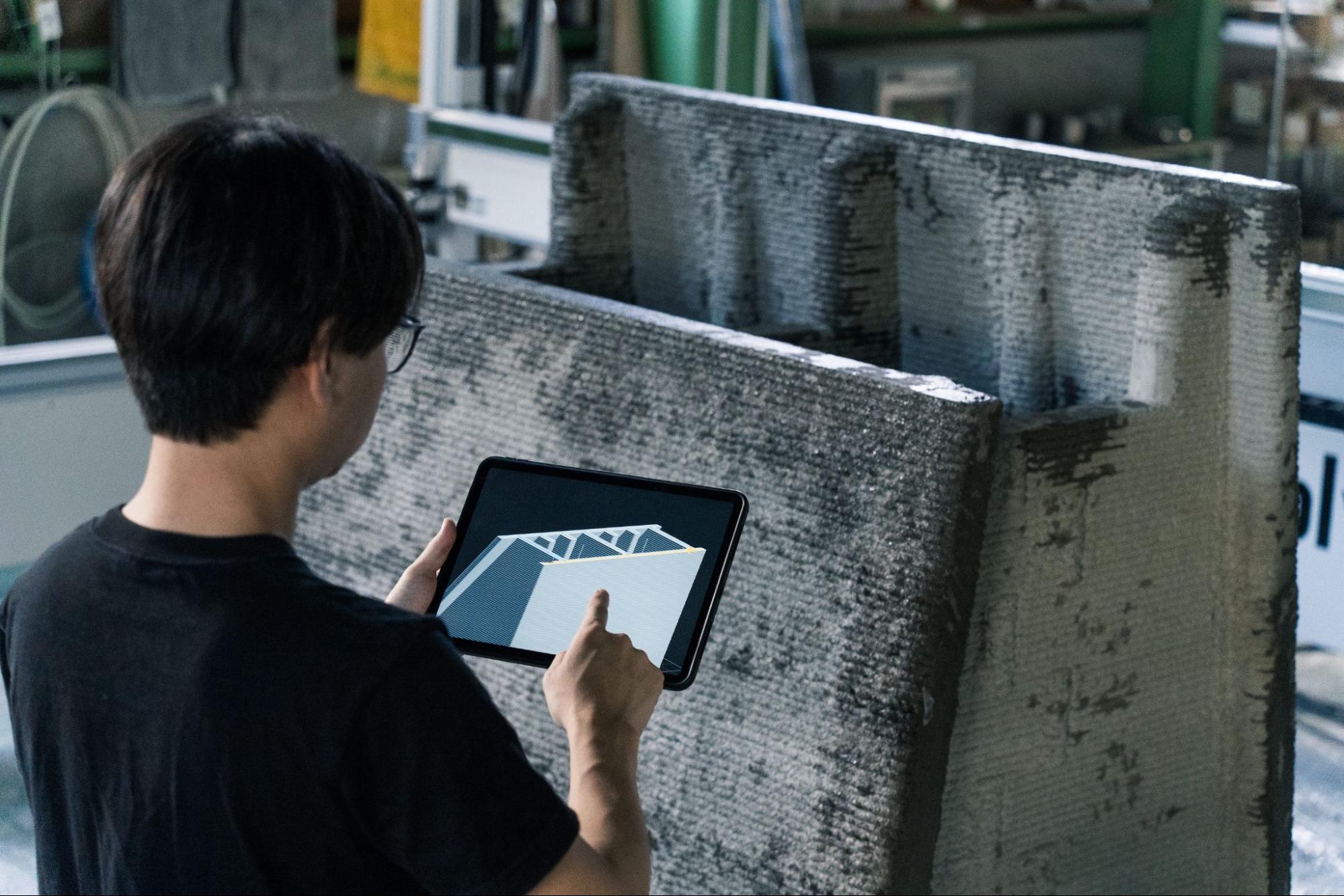
Polyuse Inc. (Headquarters: Minato-ku, Tokyo; Representative Directors: Takuya Iwamoto / Wataru Ooka; hereinafter "Polyuse") and Kyoto University's Industry-Academia Collaborative Research Division of Advanced Infrastructure Technology (Research Director: Tomoki Shiotani) have been newly selected for MLIT's "SBIR Construction Technology Research and Development Grant Program (SME and Startup Type)" and have begun developing technology that measures conditions in real time during printing with construction 3D printers. The technology will detect the residual voids*1 that form during printing as well as dimensions, contributing to better quality control.
*1 Residual voids: Gaps (voids) remaining inside a material or structure. Because they have a major impact on strength and durability, printing must be controlled so that such voids do not occur.
■Background
To achieve higher-quality, more stable printing in construction with construction 3D printers, it is important to properly control how the mortar is extruded and the shape of the structure as layers are built up. Currently, operators visually check conditions and adjust the printing parameters accordingly. In this development project, we will develop technology that automatically measures the shape and condition of the structure during printing with high precision and manages quality in real time. In the future, by feeding this measurement data back to the construction 3D printer, we aim to achieve fully autonomous operation that automatically optimizes printing conditions and delivers high-quality construction.
■Technology overview
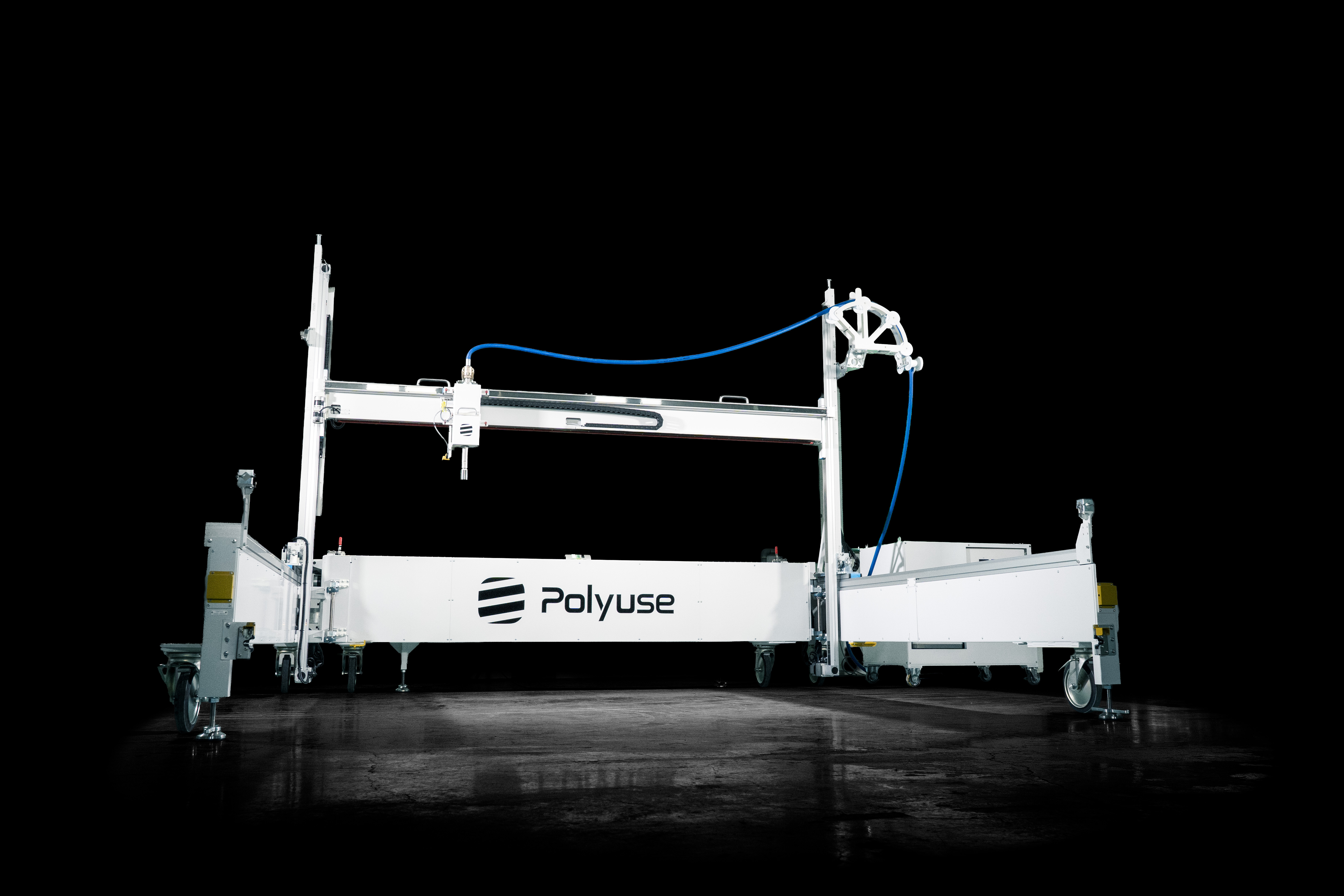
"Polyuse One," our mass-production construction 3D printer
A sensor mounted on the nozzle scans the printed surface, and the scan data is linked to X-ray CT measurements of residual voids in the cured mortar and to its strength in order to evaluate print quality.
We will first verify the feasibility of estimating residual voids from surface scans, and then aim to complete the implementation and demonstration of the measurement system on an actual construction 3D printer by March 2029.
■Comment from Atsushi Tomoyose, Program-Specific Senior Lecturer, Industry-Academia Collaborative Research Division of Advanced Infrastructure Technology, Growth Strategy Headquarters, Kyoto University
By March 2029, when the project ends, cumulative sales of Polyuse One are expected to reach several hundred units, and the machines are likely to be used more and more in regions where labor shortages are even more severe. This technology development, which will enable further labor savings with construction 3D printers, is an urgent priority, and we will see it through to a completed demonstration on an actual machine.
■Features of construction 3D printing technology
The construction 3D printing technology developed by Polyuse manufactures concrete structures and formwork by printing a dedicated mortar material layer by layer based on 3D drawing data. By eliminating materials and processes that are otherwise essential to manufacturing concrete structures, such as formwork, the technology aims to raise on-site productivity through labor savings and a shorter construction period.
◼About Polyuse Inc.
Polyuse Inc. is Japan's only manufacturer that researches and develops construction 3D printers optimized for Japanese construction sites. We provide integrated solutions that span the development of hardware, software and materials through to on-site construction support.
In January 2022, our technology became the first of its kind in Japan to be adopted for construction work under MLIT's jurisdiction. Since then, we have built a track record of more than 300 construction projects, mainly in public works, and hold a share of more than 90% of civil engineering construction with 3D printers in Japan. In September 2025, we began selling our mass-production construction 3D printer "Polyuse One," and a plan to install 100 units nationwide by FY2026 is under way.
3D printer "prints" a retaining wall on site: the nozzle moves automatically and finishes in 50 minutes
https://xtech.nikkei.com/atcl/nxt/column/18/02011/121100041/
IT company NTT DATA turns to 3D printers for building renovation in a bid to cut construction costs
https://xtech.nikkei.com/atcl/nxt/column/18/00154/02788/
JSCE issues its first technical guidelines for construction 3D printers, paving the way for wider use in public works
https://xtech.nikkei.com/atcl/nxt/column/18/00142/02349/
TV Tokyo: AKB48 drops in! What's the No. 1 DX at your company? [What new technology is shining in the labor-strapped construction industry?]
https://www.youtube.com/watch?v=xEJ-tucZNCI
TV Tokyo: Nippon! Who Knew Such a Future Was Possible – Transformation Projects at Major Corporations
https://youtu.be/5rjE8228olA
Company name: Polyuse Inc.
Location: 2-2-15 Hamamatsucho, Minato-ku, Tokyo
Representative Directors: Takuya Iwamoto / Wataru Ooka
Founded: June 2019
URL: https://polyuse.xyz/
X (formerly Twitter): https://twitter.com/polyuse
[Inquiries regarding this release]
Polyuse Inc. Public Relations Department
URL: https://polyuse.xyz/contact/
Email: pr@polyuse.xyz