Polyuse Inc. (Headquarters: Minato-ku, Tokyo; Representative Directors: Takuya Iwamoto / Wataru Ooka; hereinafter "Polyuse"), a developer of construction 3D printers, and Kato Gumi Co., Ltd. (Headquarters: Miyoshi City, Hiroshima Prefecture; Representative: Shuji Kato; hereinafter "Kato Gumi") jointly conducted the first demonstration in the Chugoku region of construction DX using construction 3D printers as a way to raise productivity, under PRISM (Note 1), an MLIT-led program.
- Background and purpose
Under the concept "Aiming to be a company that moves the future of community development forward," Kato Gumi has pursued many advanced construction DX initiatives to date. With an extensive track record that includes the i-Construction Grand Prize (Minister of Land, Infrastructure, Transport and Tourism Award), the Chugoku i-Construction Award and recognition as a Chugoku ICT Support Top Runner company, it is one of the construction companies at the cutting edge of the industry.
We strongly identify with Kato Gumi, which has continued to take on bold challenges for more than 80 years since its founding, and we have now formed a partnership to advance construction DX in the construction domain together using Polyuse construction 3D printers.
In addition, with the aim of further expanding the adoption of construction 3D printers in Japan, this PRISM project is Japan's first industry-government-academia collaboration of its kind, with the Hiroshima National Highway Office (Note 2) of MLIT's Chugoku Regional Development Bureau and Hiroshima University also taking part.
Going forward, we will further speed up development and verification, carry out extensive demonstrations and build up data day by day, advancing construction DX that is firmly grounded in practice.
As a venture company driving construction DX, Polyuse, a developer of construction 3D printers, is pursuing Japan-first initiatives and research and development under the concept of "construction in which people and technology coexist," developing technology that will become part of everyday construction and helping to build a construction environment that is safer, more productive and more efficient.
- PRISM demonstration overview
In this demonstration, with the aim of raising productivity on construction sites, a construction 3D printer (Note 3) was used at an actual construction site under Kato Gumi's construction management to manufacture drainage civil engineering structures on site.
Then, under the leadership of Professor Nakarai of Hiroshima University, the manufactured structures underwent tests including changes in initial hardening depending on the curing environment (outside air temperature), estimation of the long-term deterioration of 3D-printed objects, and changes in strength development. Going forward, we will continue to accumulate and publish the data needed for construction with construction 3D printers in Japan.
- Period: December 13–17, 2021
- Location: Construction site of the FY2020 Aki Bypass Terabun District Improvement Work No. 4 (Contractor: Kato Gumi Co., Ltd.)
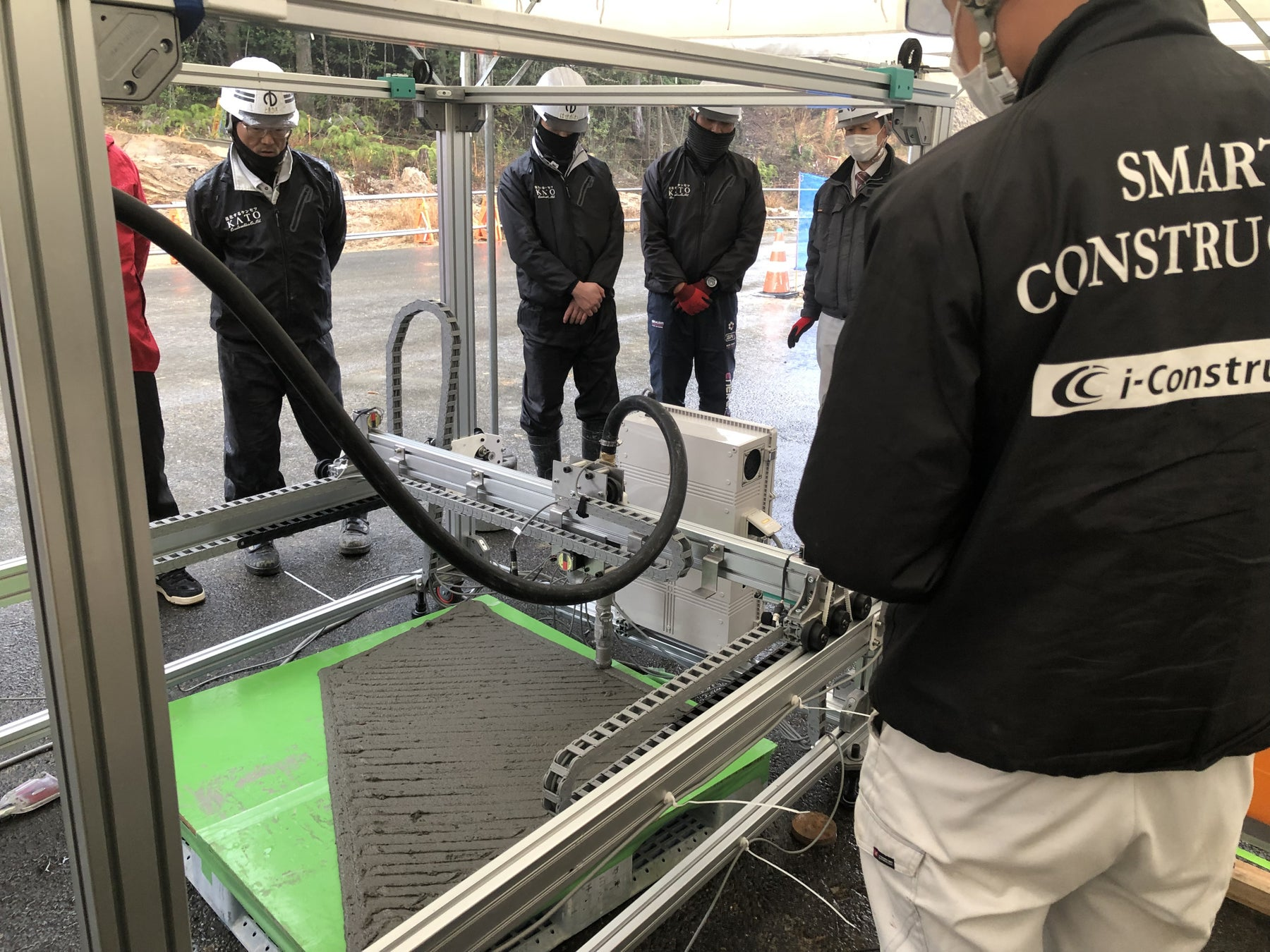
[On-site printing by Kato Gumi]
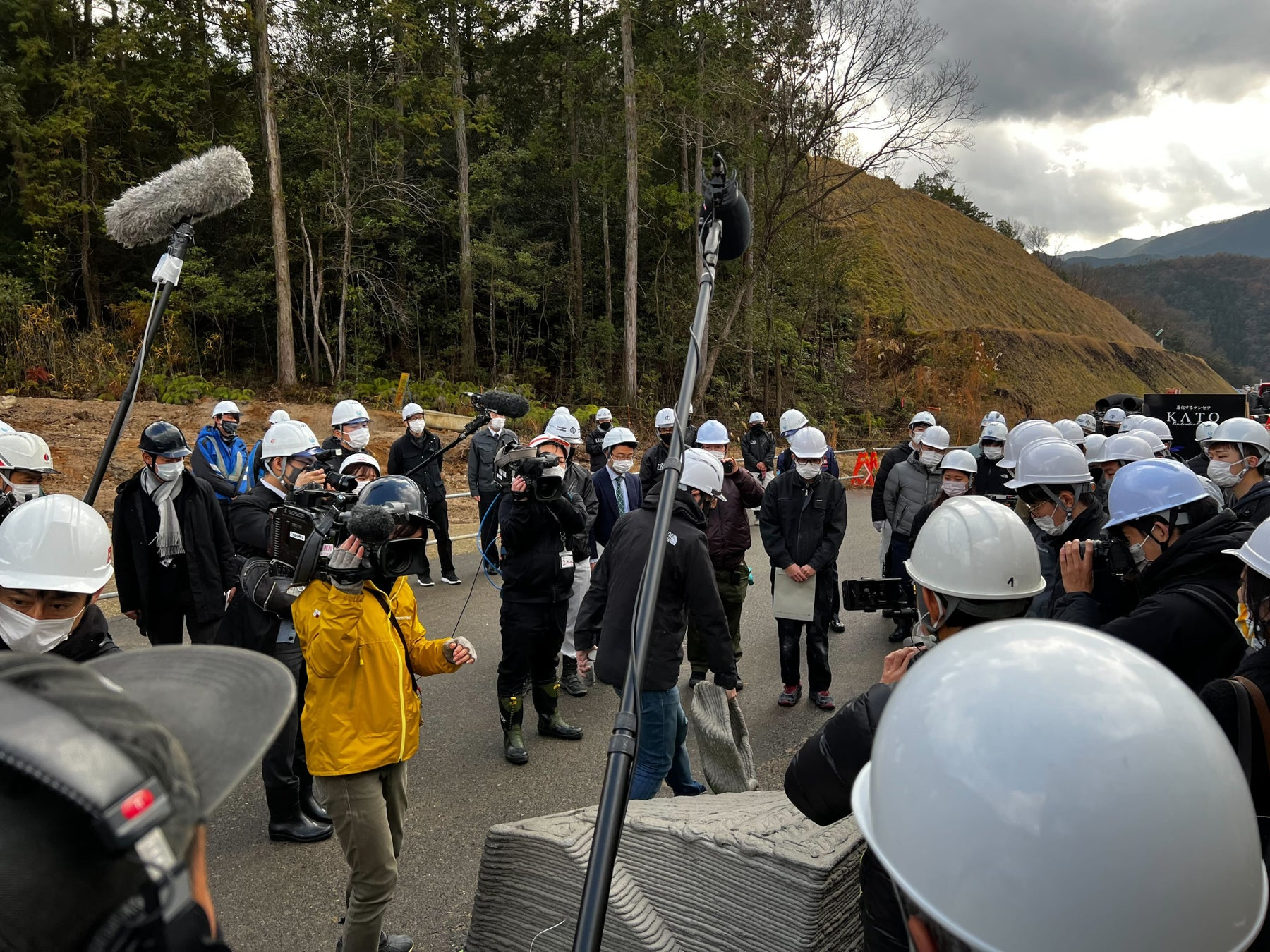
[Many representatives of related companies and members of the press visited during PRISM (Note 4)]
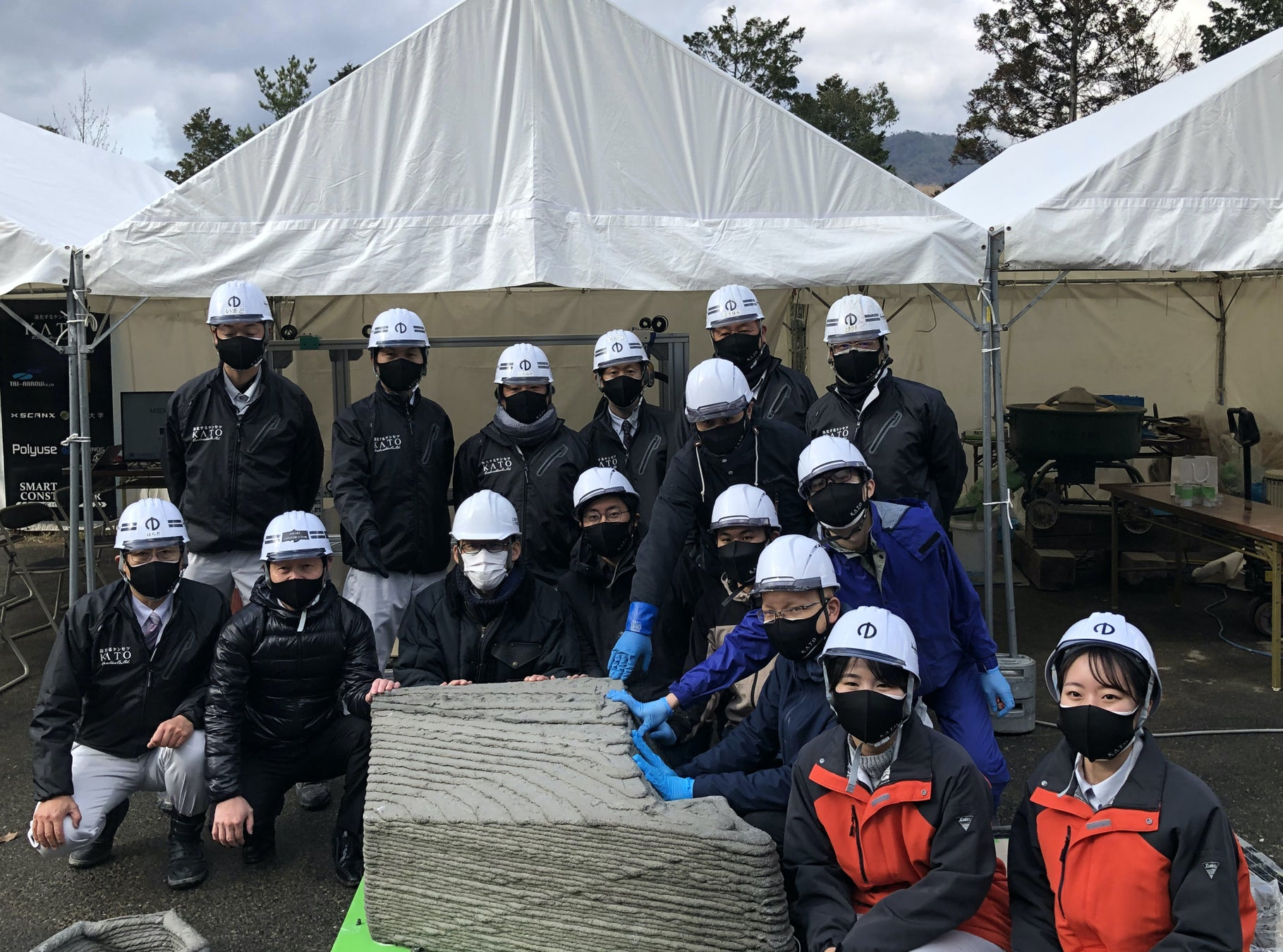
[Group photo of Kato Gumi, Hiroshima University and Polyuse]
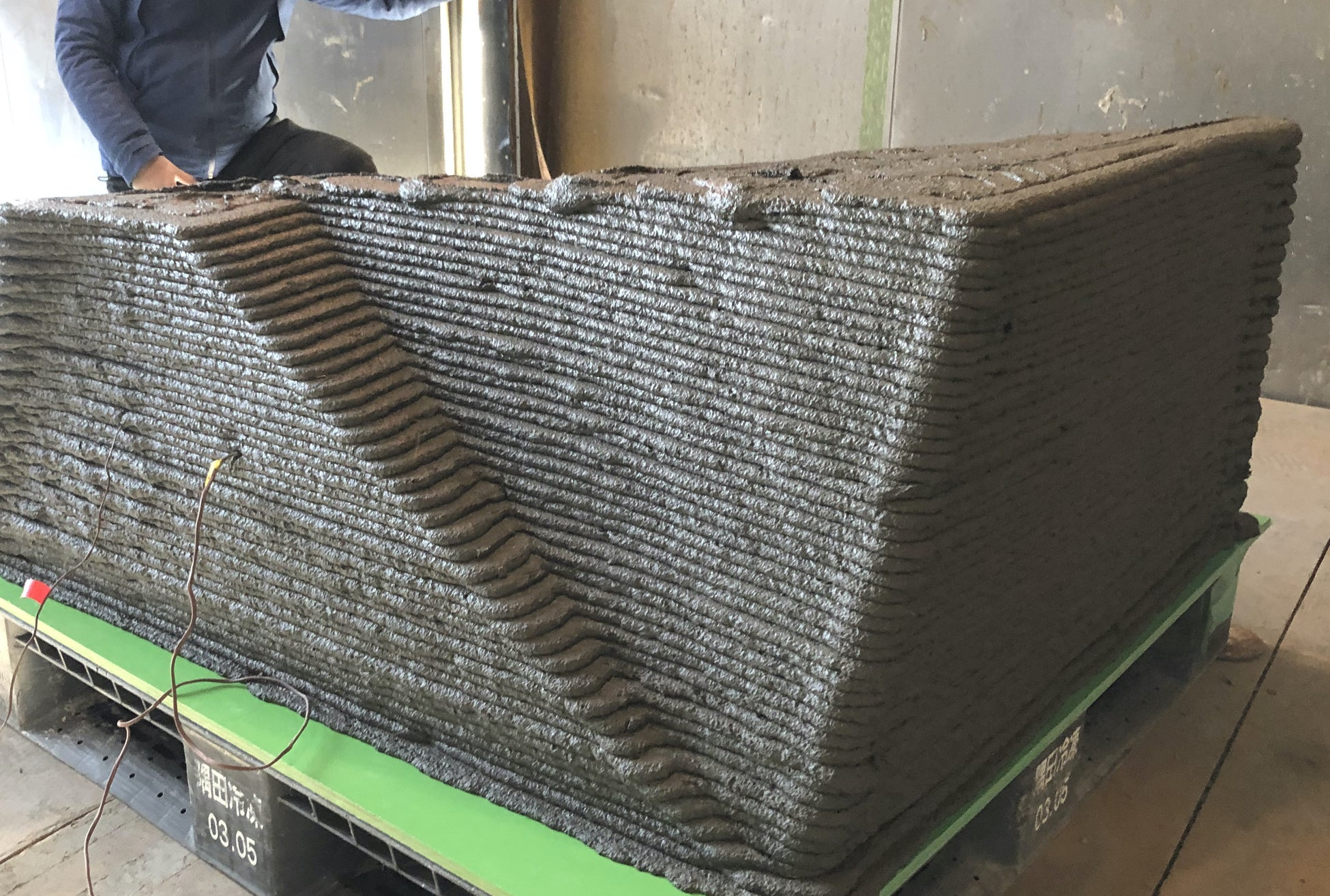
[Hiroshima University carried out a range of tests on the printed structures]
- Comment from Shuji Kato, Representative of Kato Gumi
In the past, Japan's construction industry was led by superman-like craftsmen with a strong work ethic, ingenuity and robust physiques, and it was they who built the infrastructure we have today. With the passage of time, however, those dependable men have grown old and are gradually leaving the field of construction. We have now entered an era in which we must pool our collective wisdom and build new construction systems. To do so, I felt that collaborating with creative groups with fresh sensibilities, who had no previous connection to the existing construction industry, was essential. It was while exploring the potential of construction 3D printers that we met the creative group that is Polyuse. Polyuse has deliberately chosen not to adopt the robotic arms that are mainstream overseas. I believe this is because they understand that a simple, inexpensive structure that is resistant to breakdowns suits the needs of Japan's small and medium-sized construction companies better than a complex, expensive one. Yet within a simplicity that at first glance looks as though even an amateur could build it lies carefully considered ingenuity. Every time I see it, it has been improved and continues to "evolve." They are also making various improvements to the material itself, concrete mortar, approaching it from a different angle than before. In this PRISM project, with the cooperation of Hiroshima University, which tests the quality and strength of the finished concrete products, their work may "evolve" further into the development of higher-performance, lower-cost concrete mortar.
Through industry-government-academia initiatives such as this PRISM project, I want to contribute to the future of the construction industry from here in Hiroshima. And as a partner in the "evolving construction" that we at Kato Gumi champion, I look forward to Polyuse's continued "evolution."
- Comment from Professor Nakarai, Graduate School of Advanced Science and Engineering, Hiroshima University
I expect construction 3D printers to be an innovative technology with the potential to dramatically transform the construction industry, and concrete work in particular. Concrete construction today presupposes a process of assembling formwork and placing concrete into it, but if formwork is no longer needed, any shape can be fabricated freely. Waste will also decrease, and the shortage of skilled engineers can be addressed. As for concrete quality, at present the surface condition cannot be checked until the formwork is removed after hardening, whereas with 3D printing the surface condition can be checked directly during construction, and any problems can be repaired before the concrete hardens. The construction sequence also becomes dramatically more flexible, so I believe construction will be optimized under new conditions, for example by embedding appurtenances during printing.
The Polyuse members who handled the 3D printing of concrete for PRISM include many young people whose expertise lies outside the construction field, which may be why their thinking is so flexible, and I look forward to their proposals for new possibilities in this highly flexible printing technology. Their technical capabilities to back this up are also more than sufficient, as shown by the fact that they put a highly refined printer into practical use in a short time, and I have high hopes that they will become pioneers who open up a new era. Speaking for the university where I serve on the faculty, I also felt keenly the importance of conveying the prospects of innovative technology to the students who will lead the next generation of the construction field. Many students did not know that the development of construction 3D printers had come this far. On the other hand, although construction methods will change dramatically with construction 3D printers, I believe that as long as the materials used are cementitious, much of the knowledge from the conventional field of concrete engineering can still be applied. Through collaboration such as joint research with industry and government, I hope to contribute to the establishment and dissemination of this technology.
(Note 1)
Currently, the construction industry, led by MLIT, is promoting i-Construction, which uses ICT and other technologies across every construction production process, with the goal of raising productivity at construction sites by 20% by FY2025. As part of this effort, PRISM is a project for the introduction and use of innovative technologies to dramatically improve productivity at construction sites.
(Note 2)
Announcement on this project from the Hiroshima National Highway Office
https://www.cgr.mlit.go.jp/hirokoku/p_release/pdf/2021press/211210press.pdf
(Note 3)
Polyuse develops 3D printers of various sizes and mechanisms to suit different use cases. The construction 3D printer used this time is a compact, highly portable model capable of printing objects up to about 1 m in size.
(Note 4)
NHK: University students visit a site to see 3D printers used in construction
https://www3.nhk.or.jp/hiroshima-news/20211217/4000015521.html
TSS: "3D printer" used at a construction site in the first demonstration on a national government project, Hiroshima
https://www.tss-tv.co.jp/tssnews/000012628.html
Hiroshima Home Television: Demonstration of making building components with a 3D printer, Hiroshima
https://www.home-tv.co.jp/news/content/?news_id=20211217131554
- We're hiring as our business grows rapidly!
Polyuse is currently actively recruiting, especially for our engineering team.
Many of our team members hold master's or doctoral degrees. Each brings their own area of expertise, a strong sense of responsibility and a perspective that values building things to make the construction industry better, and we place great importance on being the best possible team: one that always keeps the job site in mind, enjoys tackling challenges and keeps honing its technology.
In Polyuse's development work, we pursue business together with many partner companies, universities, research institutions and others, and our engineers go out into the field themselves to bring cutting-edge R&D into real-world use.
We would love to build a team that can further update the industry together with people who combine a strong interest in solving the construction industry's challenges with proven ability and achievements in their own fields. If the challenge of transforming the construction industry through technology development excites you, please get in touch via our corporate website below.
https://polyuse.xyz/recruit/
■About Polyuse Inc.
Company name: Polyuse Inc.
Location: 2F, 2-2-15 Hamamatsucho, Minato-ku, Tokyo (development base: Kamakura City, Kanagawa Prefecture)
Representative Directors: Takuya Iwamoto / Wataru Ooka
Business: Planning, design, manufacturing and sales of hardware, software and services specialized for the construction industry, centered on construction 3D printers
Founded: June 2019
URL: https://polyuse.xyz/
[Media inquiries regarding this release]
Polyuse Inc. Public Relations Department
Email: info@polyuse.xyz