Kaetsu Construction Co., Ltd.
A construction 3D printer cut the overall schedule by 1.5 months and improved profitability! A channel-widening project that avoided disrupting the farming season
Challenges
Avoiding impact on the farming season under a tight construction period
Delays were not an option, so as not to affect nearby farmers' rice planting (and their use of irrigation water) starting in April
Construction difficulty due to a complex shape
With many young workers in their teens and twenties who had little experience assembling formwork, forming a retaining wall with a complex shape whose cross-section changes from sloped to vertical was difficult
Rising costs of temporary materials and more
A longer construction period tended to drive up lease fees for temporary materials such as steel road plates, as well as heavy machinery and labor costs
Results
1.5 months cut from the overall site schedule
With less on-site work, parallel construction with other work types (building a temporary passageway, box culvert work, etc.) became possible, shortening the overall construction period by 1.5 months
Formwork work period cut by more than 70% (76.7%)
The one-month work period originally assumed for formwork assembly and curing was reduced to one week by adopting components fabricated with a construction 3D printer
Labor reduced by 80%
Labor was sharply reduced from the roughly 50 total person-days originally assumed to 10. Formwork carpenters were no longer needed, and construction was completed in collaboration with a single civil engineering contractor
People featured
 Kaetsu Construction Co., Ltd.Construction Section ManagerHiroyuki Kato
Joined the company in April 1998. First-Class Civil Engineering Construction Management Engineer. Has consistently handled site management. In his private life, he is a father of three who enjoys mountain climbing. Placing great value on teamwork within the company and on site, he is dedicated to changing the image of the construction industry by “creating bright, enjoyable worksites” and actively introducing the latest technologies
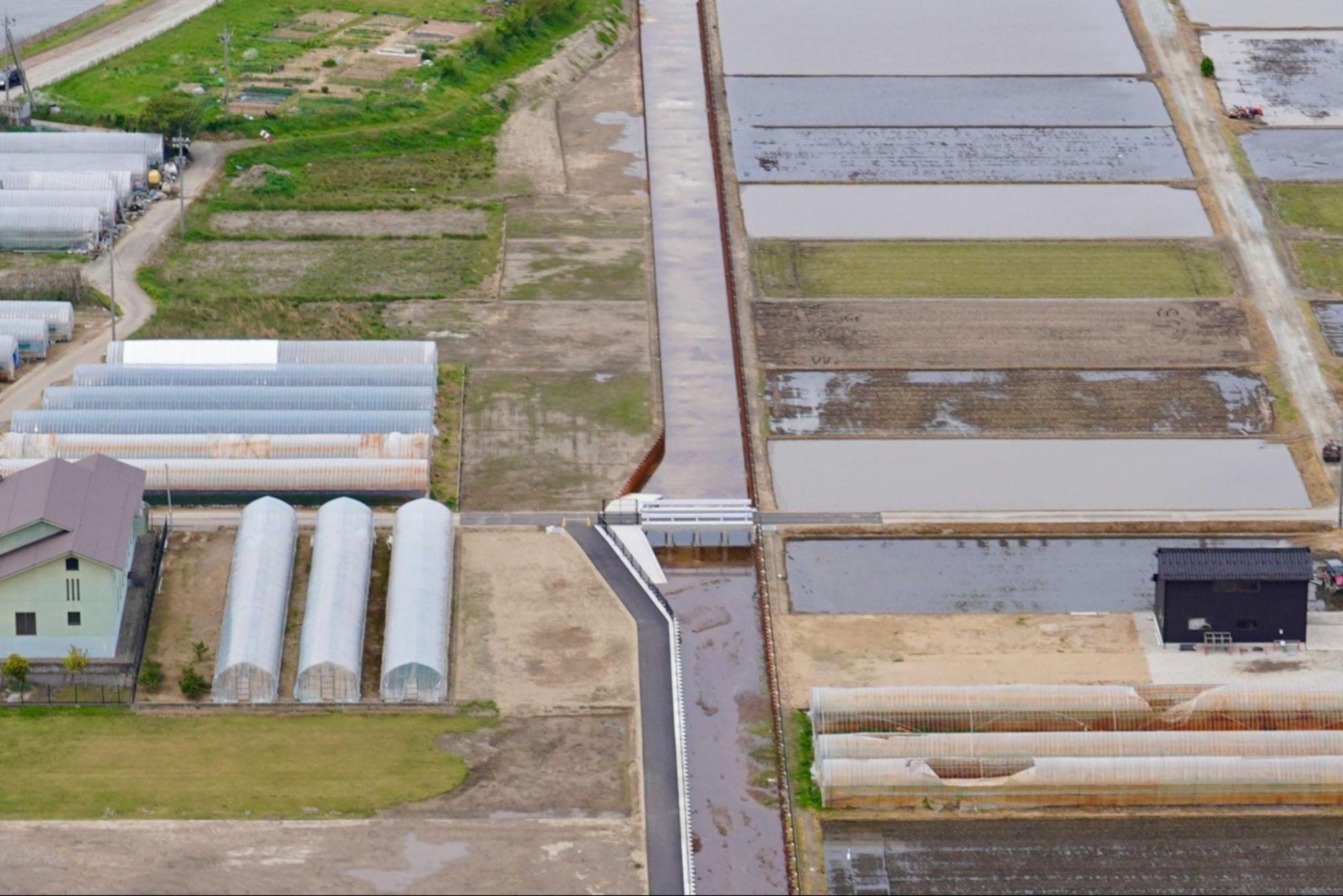
This case study features Kaetsu Construction Co., Ltd. of Komatsu City, Ishikawa Prefecture, which used a construction 3D printer to build channel retaining walls on the “Ishibashi River Drainage District Conveyance Channel and Related New Construction Work (Section 5)” (client: Komatsu City, Ishikawa Prefecture), a project to widen a waterway and improve drainage capacity following heavy-rain damage in 2022. The company faced a tight construction period that could not be allowed to delay the rice-planting season (and the use of irrigation water) starting in April, as well as a complex shape whose cross-section changes from sloped to vertical, which made construction with conventional formwork highly difficult. With construction 3D printing technology, the company shortened the work period and achieved significant labor savings. We spoke with Hiroyuki Kato, the company's Construction Section Manager, about this project, which achieved smooth construction timed to the rice-planting season and was highly praised by both the client and local residents.
Expanding local drainage capacity: a tense schedule that risked affecting April's rice planting
—— Please give us an overview of the “Ishibashi River Drainage District Conveyance Channel and Related New Construction Work (Section 5)” and the challenges you faced on site before construction began.
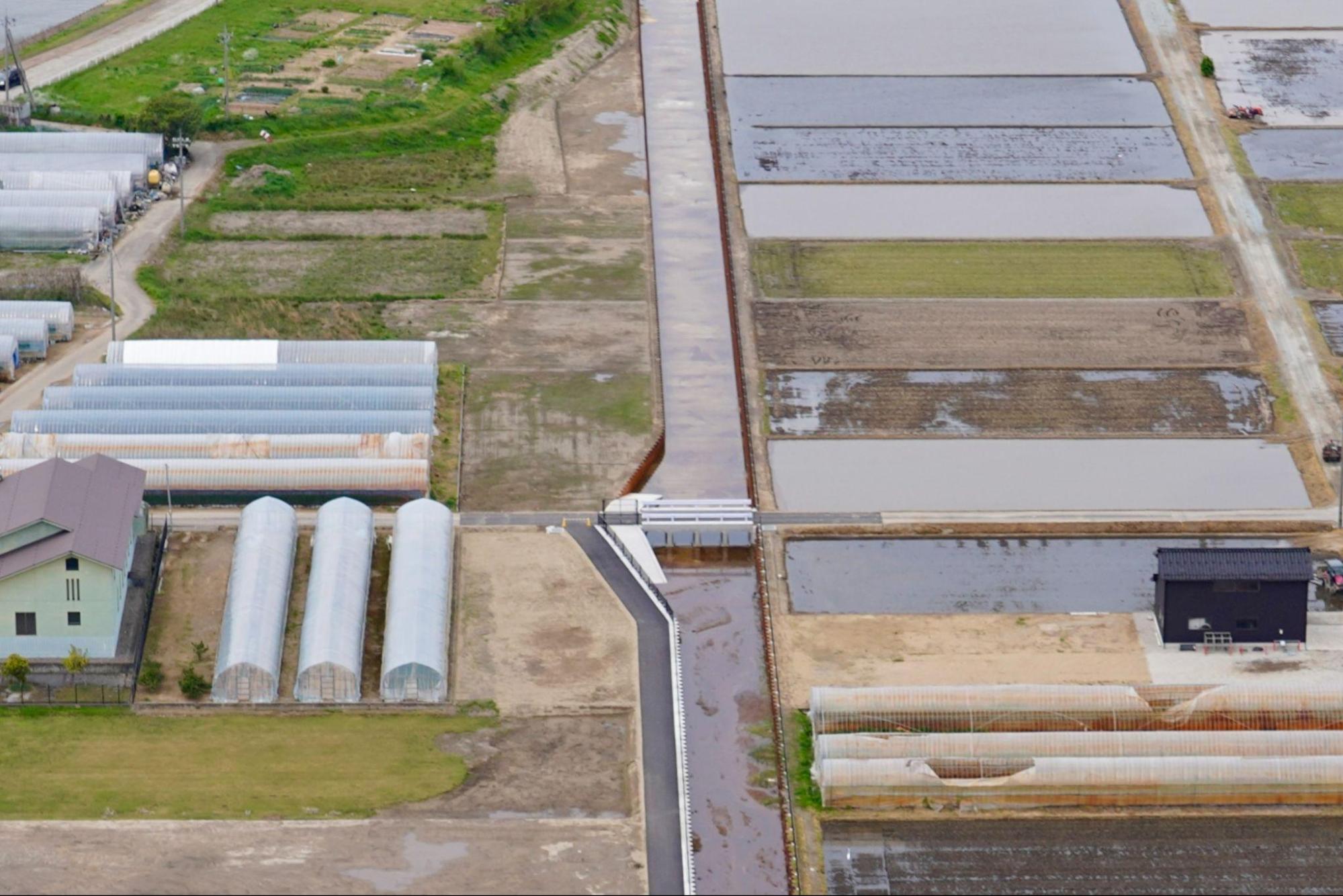
It is an important improvement project to widen a conveyance channel and improve the area's drainage capacity, in response to the heavy-rain damage that occurred in Komatsu City, Ishikawa Prefecture, in 2022.
The biggest challenges in starting construction were the “strict construction period” and “consideration for nearby farmers.” There are rice paddies near the site, and in Ishikawa Prefecture, field work in preparation for rice planting gets into full swing around April every year. The construction period ran until the end of May, but if irrigation water became unavailable from April onward or the work fell behind, it would cause serious trouble for local farmers' operations. At the time, the “rice shortage” was a major topic across society, and we had a strong sense of mission: “We want to finish the waterway as soon as possible so they can start growing rice in spring with peace of mind.”
Furthermore, in terms of construction, the channel retaining wall on this project had a complex shape whose cross-section changes from sloped to vertical. Building it with cast-in-place concrete during the cold winter season would have required scaffolding and complex formwork, and we expected it to take nearly a month including curing. The risk of construction delays and rising costs were major concerns.
—— Under those circumstances, what prompted you to consider using construction 3D printing technology, and what was the deciding factor?
I had already seen Polyuse's construction 3D printing technology in media such as YouTube and TV, and I was strongly interested, thinking, “This is fascinating. It's a technology that will definitely be needed in the future.” I have assembled formwork myself, and formwork work takes a great deal of thought; with craftsmen aging, passing skills on to young people is not easy either. I judged that a construction 3D printer was ideal precisely for a site like this one, with a complex shape and a short construction period.
My motto is “creating bright, enjoyable worksites.” I'm always thinking, “I want to take on new technologies myself and change the industry with our own hands.” The construction industry today has few young entrants, and its age structure is skewed, centered on people in their 50s and older. It is also true that there is a generational gap in familiarity between seasoned skills and the latest DX tools. That is exactly why I felt that we, the “in-between generation” positioned in the middle, have a role to play as a bridge, actively adopting new technologies and changing the image of the worksite.
—— How did the client, Komatsu City, as well as people within your company and the craftsmen on site react?
When I brought Polyuse's materials and catalogs to the client, Komatsu City, and made the proposal, they responded positively at the very first meeting: “That's interesting! Let's give it a try.” Since we shared the desire to minimize the impact on farmers, they were extremely cooperative.
Within the company, there were initially voices of concern about cost and other aspects, but encouraged by employees who strongly backed the initiative, the decision was made to take on the challenge. When I showed videos to the young workers and craftsmen in charge of the site, they got really fired up: “We definitely want to do it!”
I also showed the videos to local farmers and residents who came to see the site and explained, “Using this construction 3D printing technology, we can greatly shorten the construction period and be ready in time for rice planting from April,” and they showed great interest.
Less on-site work and more working space enabled parallel construction across multiple processes, cutting the overall schedule by 1.5 months and improving profits
—— What specific benefits did you achieve in actual construction?
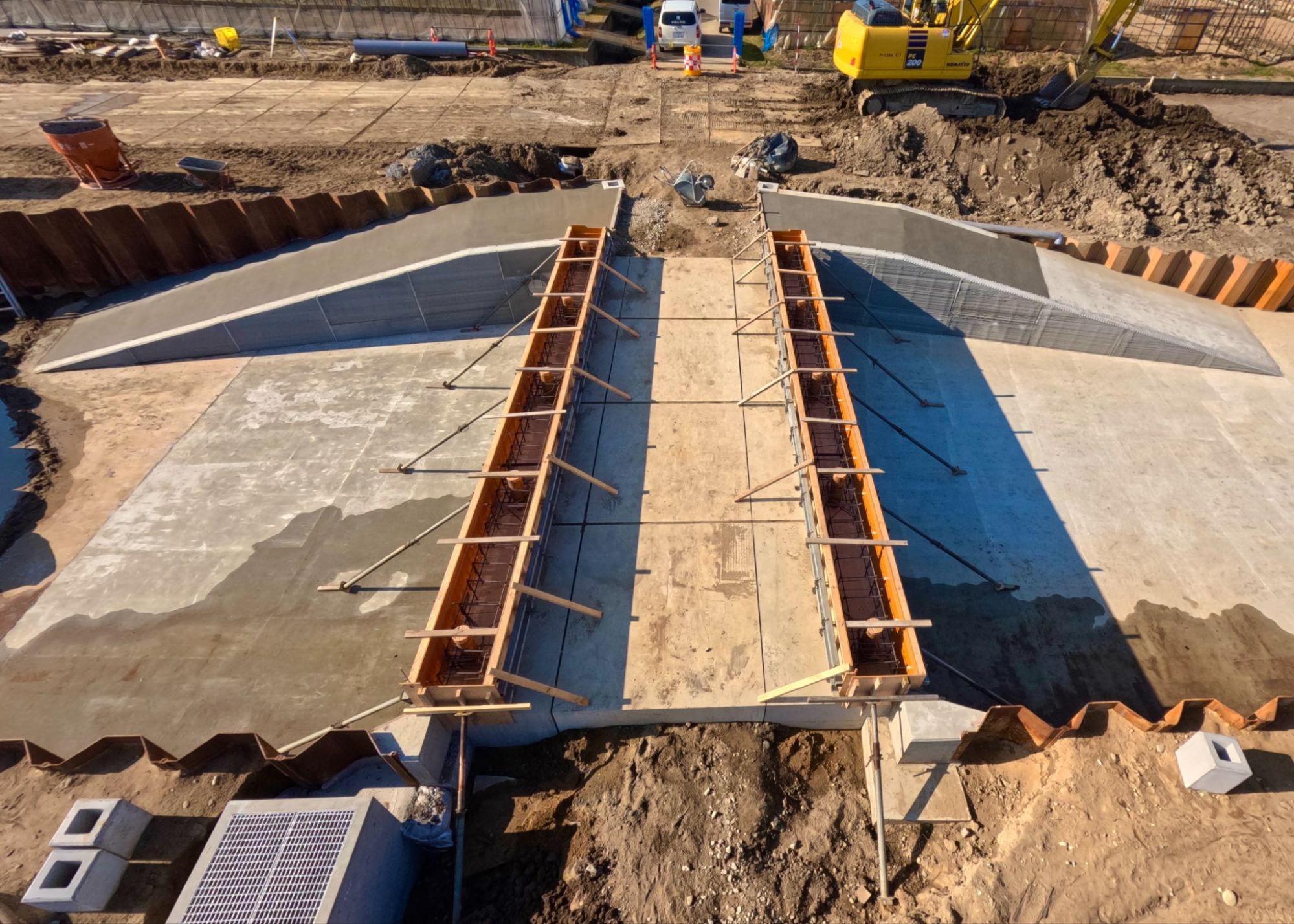
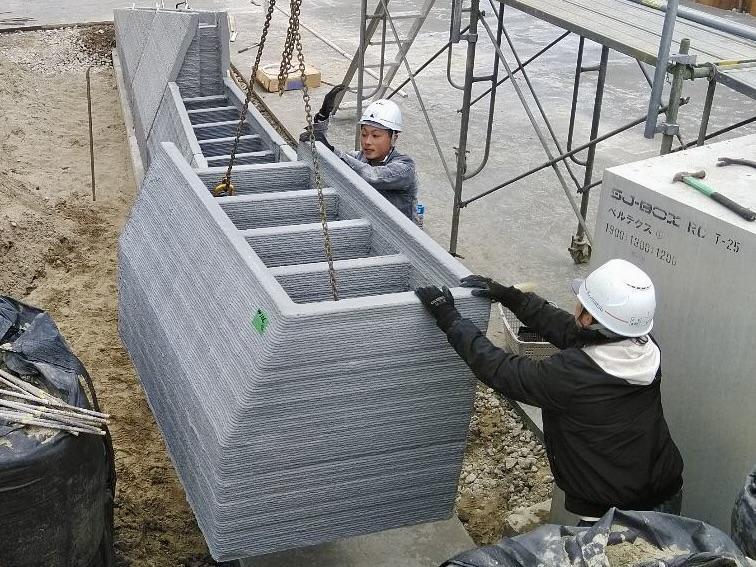
The biggest result was that we were able to skip the entire process of assembling and dismantling formwork on site. Work that we had originally expected to take about one month (about 30 days) for formwork assembly and curing was completed in just one week (about 7 days) by installing construction 3D printer components and precast products*1, cutting the work period by roughly 80% (76.7%).
We also achieved major labor savings in terms of the number of workers (person-days). With the conventional formwork method, we had expected a total of about 50 person-days, including formwork carpenters and material transport, but construction with the construction 3D printer proceeded smoothly with a small crew of two or three people, keeping it to a total of 10 person-days (an 80.0% reduction).
By using chains to fine-tune the wire length of the lifting jig, leveling the components during installation was also easy, and the site workers were surprised: “Is it really this simple?”
In terms of the construction setup, there was no longer any need to arrange and coordinate specialist formwork contractors, and on-site construction could be completed in collaboration with just one civil engineering contractor. This has also greatly reduced the burden of administrative work, such as preparing the construction system ledger and coordinating schedules among multiple contractors.
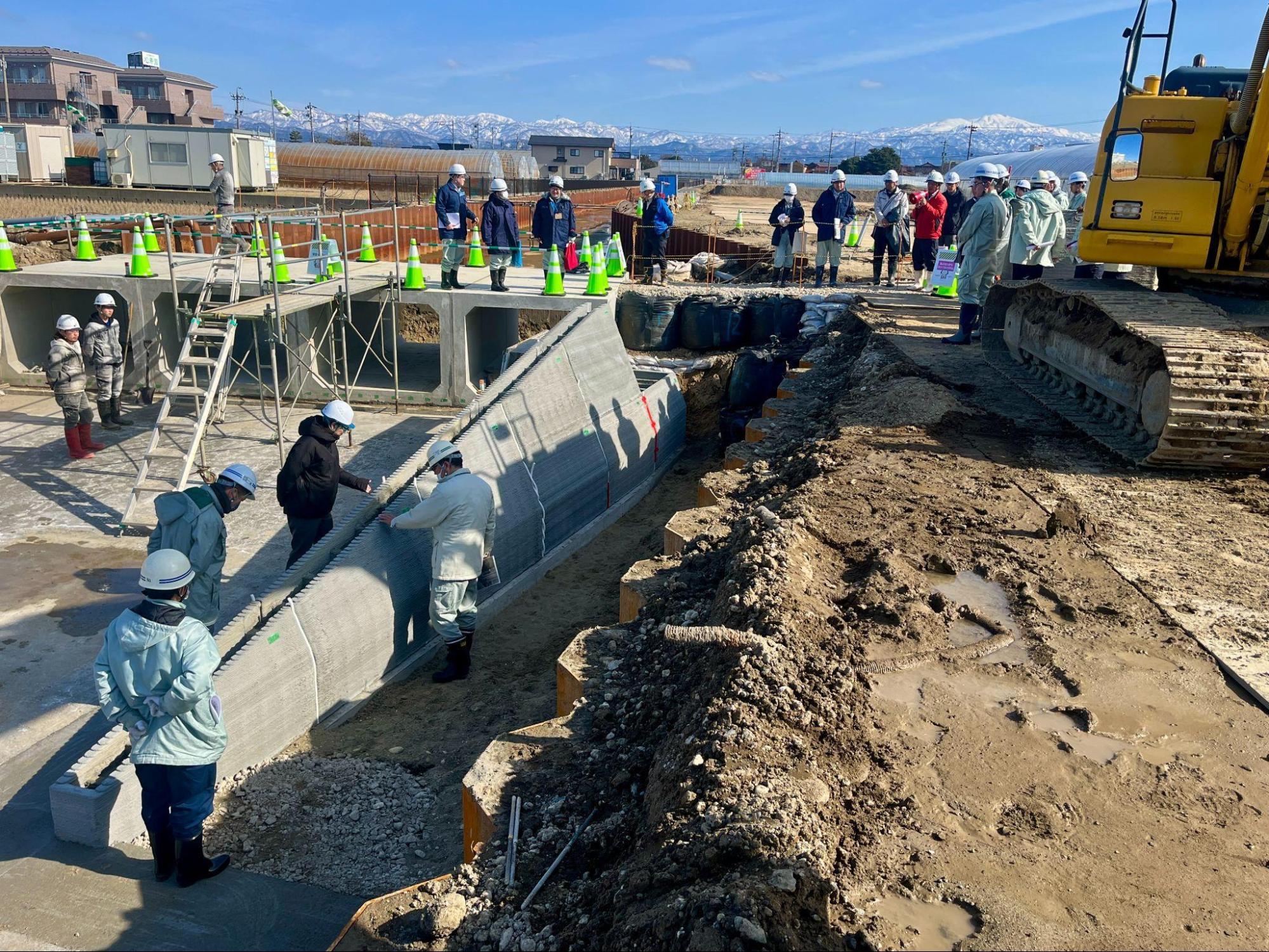
With less on-site work and more room in both space and schedule, other processes could be carried out in parallel, such as removing the temporary passageway, working around the adjacent box culvert, and pouring the base slab concrete. As a result, we were able to shorten the overall site schedule by 1.5 months.
*1 Precast products: Concrete products manufactured and formed in advance at a factory or similar facility
—— What changes did you see in terms of costs and profits?
Because the overall construction period was shortened by 1.5 months, expenses such as long-term lease fees for 500 temporary steel road plates, heavy machinery costs, safety facility costs, and staff labor costs were significantly reduced. Even though the cost of some individual components went up, across the project as a whole the cost savings outweighed it, and the final project profit came in substantially higher than the initial budget.
—— After the project was completed, what kind of response did you get from the client, local residents, and people within the company?
Nearby residents expressed surprise and gratitude: “It's already finished?!” We were able to be ready in time for farm work starting in April, and I feel we made a real contribution to the community.
The client, Komatsu City, also rated the project very highly. Not only did we receive a high construction evaluation score, but the site tour we held on this project served as a direct inspiration, and Komatsu City went on to commission another project using a construction 3D printer. The government side has also praised it highly as an effective means of advancing work-style reform and two-day weekends.
Members of the company who were cautious at first have also told me, after seeing the final results and the improved profits, “We're really glad we did it!” It has helped foster a company-wide spirit of taking on challenges.
From mountainous areas and rivers to parks with curved designs: the new possibilities construction 3D printers open up
—— Are there any projects or new ideas you would like to take on using construction 3D printers in the future?
Next, I would like to take on “footing (foundation)” construction for bridge piers and the like, as well as integrated channel structures that use no cast-in-place formwork at all, and we are already in concrete discussions with Polyuse and our partner companies.
Ishikawa is very mountainous, so I feel that sabo dams in mountainous areas and river works, where the presence of water makes assembling formwork difficult, are areas where the strengths of construction 3D printers really come into play. I would also like to use it for “building structures that inspire dreams,” the kind that delight children, such as park play equipment and design structures that incorporate curves. In fact, when I showed a video of construction 3D printer work to my child, who is in second grade, their eyes lit up: “Wow! That's so cool!” I'm convinced it is a technology that can convey the fun of construction to young people and children.
An era is coming in which young engineers master the latest technologies such as construction 3D printers, with people in their 50s and 60s supporting them. I look forward to Polyuse continuing to lead the industry as a partner in transforming construction sites into bright, exciting places.
Kaetsu Construction Co., Ltd.
Ishikawa
Employees (at interview)
40
Main clients
Ishikawa Prefecture, Komatsu City, etc.
Core business
Custom-built new homes, renovations and extensions, building construction, seismic retrofitting, civil engineering, development (real estate)