Hashimototen Co., Ltd.
Won the Infrastructure DX Award for Japan's first use of a construction 3D printer on a fish ladder, saving 40 working days and 40 person-days within the limited non-flood-season schedule
Challenges
A limited construction period in the non-flood season*2 and a special shape
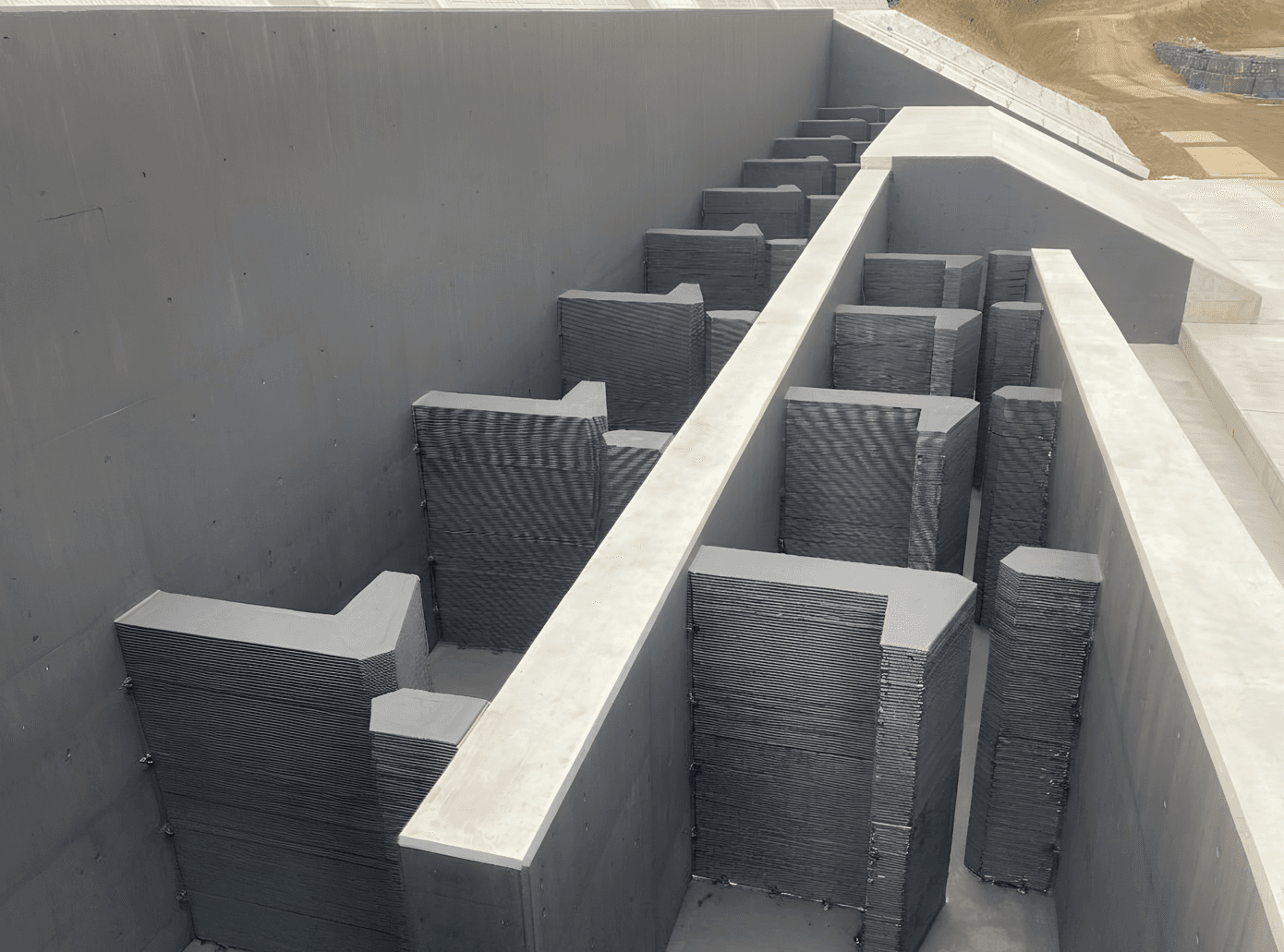
Construction had to be completed within the limited window of November to May, but because the fish ladder was a special vertical-slot type*3 for which no off-the-shelf products exist, there were concerns that the conventional formwork method would squeeze the construction period.
Soaring material prices and client demands to advance DX
While rising material prices in recent years have been squeezing business, client expectations for DX and for the use of ICT on site, as well as their requirements at process checks, have rapidly intensified over the past two to three years.
*2 Non-flood season: The period when the risk of rising river levels and flooding is low (generally around November to May), during which river works are concentrated
*3 Vertical-slot type: A fish ladder structure with vertical gaps (slots) in its partition walls so that fish can move through easily. It copes well with changes in water level, but its complex shape makes it labor-intensive to fabricate
Results
Major reductions of 40 working days and 40 person-days of labor
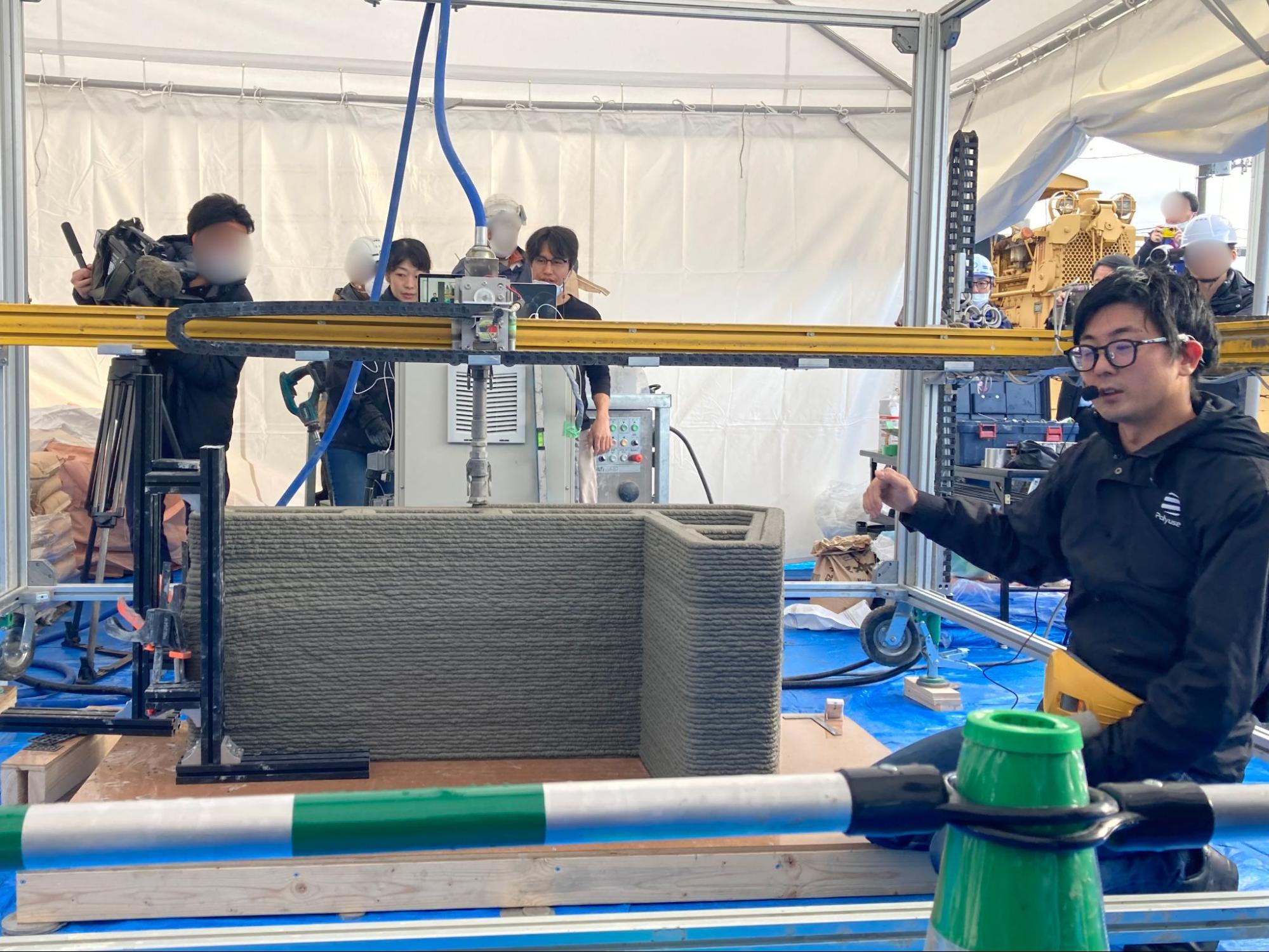
Adopting the stay-in-place formwork method*4 using a construction 3D printer eliminated much of the on-site work, such as assembling and dismantling formwork. Compared with the estimate for the conventional formwork method, construction days were cut from 78 to 37 (a 52% reduction) and labor from 127 to 87 person-days (a 31% reduction), substantially shortening the schedule and saving labor.
Industry–academia experiments demonstrated that it “helps aquatic life migrate upstream”
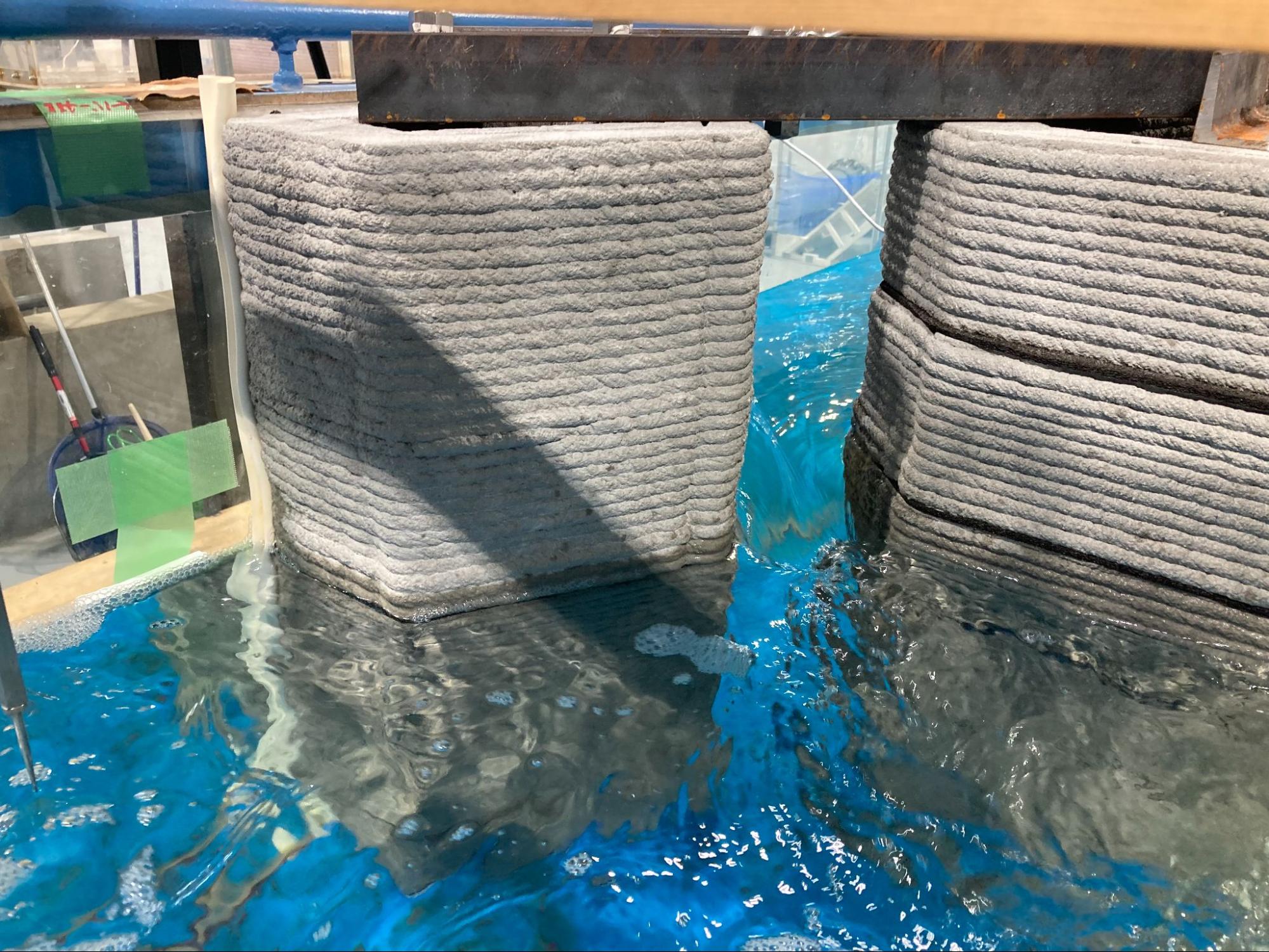
As joint research with Hirosaki University, a comparative experiment was conducted between construction 3D printed concrete (rough surface) and ordinary concrete (smooth surface). It scientifically demonstrated that the layered shape unique to construction 3D printing acts like a ladder, raising the upstream migration success rate of juvenile fish, small crustaceans, and other species with weak climbing ability.
*4 Stay-in-place formwork method: A method in which the formwork is not stripped (removed) after concrete placement but is left in place as part of the structure
People featured
 Hashimototen Co., Ltd.Senior Managing Director, General Manager of Civil Engineering HeadquartersShinji Aihara
Oversees civil engineering in general and the new technology division, and is responsible for quality control. After about 10 years working on civil engineering sites at another company, joined Hashimototen and is now in the 28th year with the company. Leads the company's entire construction 3D printer project.
 Hashimototen Co., Ltd.General Manager, Civil Engineering Department, Construction Division (Site Manager)Toshihiro Higashi
In the 14th year since joining Hashimototen. Has consistently handled on-site construction management since a previous job. Works mainly on river, road, and sabo (erosion control) projects commissioned by MLIT, and served as the site manager for this project, Japan's first fish ladder built with a construction 3D printer.
 Hashimototen Co., Ltd.Operational Efficiency Promotion SectionJunya Tsuchida
After working in on-site construction management as a temporary staff member, joined the company as a full-time employee. With the launch of the CIM*6 Promotion Section (now the Operational Efficiency Promotion Section), oversees the operation and in-house development of BIM*7/CIM, ICT, and construction 3D printer–related work across the company.
*6 CIM (Construction Information Modeling): A method of using 3D models and attribute information in the civil engineering and infrastructure field (roads, bridges, etc.) in the same way as for buildings
7 BIM (Building Information Modeling): A method used in the building field in which attribute information such as components and costs is added to 3D models so that everything from design through construction to maintenance can be managed consistently
This case study features Hashimototen Co., Ltd., a long-established company founded in 1923 that supports infrastructure in the Tohoku region, and its construction of Japan's first fish ladder (*1) built with a construction 3D printer on the “Uchikawa Basin Yamashita Weir (Right Bank) Work.” Highly praised for cutting 40 working days from the schedule and for its environmental results, the project received the Excellence Award in MLIT's “FY2025 Infrastructure DX Award.” We spoke with Aihara, who led the initiative; Higashi, the site manager; and Tsuchida of the Operational Efficiency Promotion Section.
An industry transformed in five years: clients now expect “DX on site”
—— Recently, the construction industry as a whole has been going through many institutional and environmental changes, such as the push for work-style reform. What changes in particular have you felt firsthand?
Aihara: The biggest challenge, without a doubt, is developing and retaining young people. Lately, I feel we need to adapt how we work and communicate to the times. In particular, I believe new approaches that reduce the burden on our sites are essential.
Higashi: On site, the surge in material prices over the past few years has been a real headache. Beyond that, I feel that clients (government agencies) have started placing far more weight on efforts around DX and new technologies over the past two to three years.
When we highlight ICT and new initiatives at the regular process checks, clients now show extremely strong interest. Compared with the past, procedures such as document submissions have been simplified, and on-site hardware, starting with surveying instruments, has evolved tremendously.
Tsuchida: In my area, ICT construction management, 3D surveying has become fully established. With BIM/CIM, a wave of “application in principle” came around FY2019 to FY2022 and generated a lot of excitement, but lately there are cases where design consultants still rely heavily on 2D drawings, so we have entered a more advanced stage in which contractors need to be creative in how they put it to use.
If we were going to do it, we wanted a big challenge that adds value
—— Against that backdrop, what prompted you to try using a construction 3D printer?
Aihara: We had always wanted to dramatically improve productivity at our construction sites, and it started when Hokuetsu Co., Ltd. introduced us to Polyuse's construction 3D printer. When we were first approached about applying it to a fish ladder, the actual construction was scheduled for the following fiscal year, so I thought, “Precisely because a few cases are already starting to appear, rather than simply using it, I want to take on a big challenge that adds value no other company has.”
—— Higashi and Tsuchida, you were entrusted with the site. What did you think when you first heard about this?
Higashi: There was something like an internal open call asking, “Is there a site where we could use a 3D printer?” I suggested, “Why not try it on this fish ladder project I'm handling?” But since the shape was complex and the size was large, at first I was half joking (laughs).
When it was actually decided that we would do it, to be honest, I was more anxious than anything else. Could the bumpy shape peculiar to fish ladders really be printed cleanly? Above all, would we really get approval from the client? With no precedent, we were feeling our way.
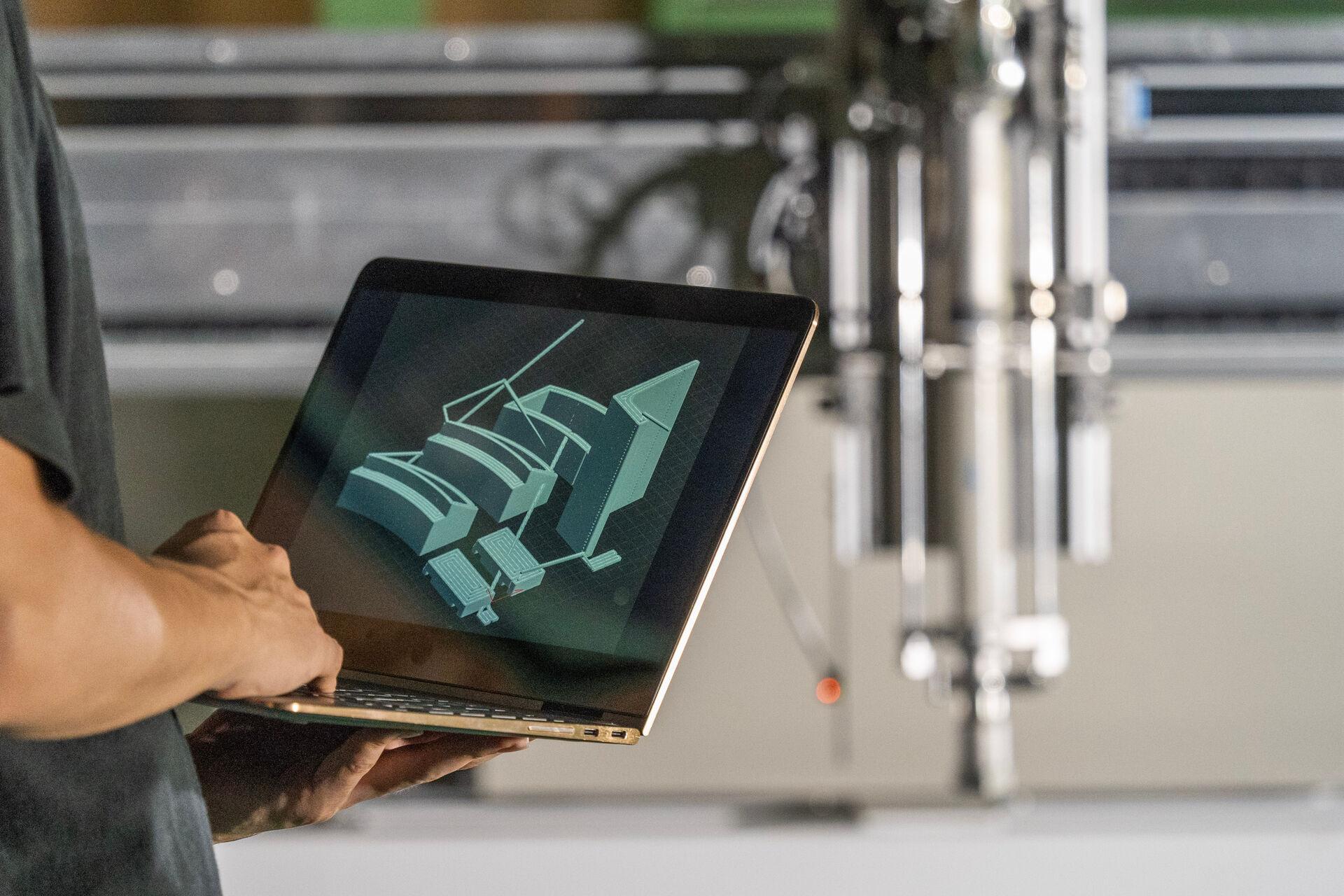
Tsuchida: From my position in the Operational Efficiency Promotion Section, I personally got excited, thinking, “This looks really interesting.” I create 3D models on a daily basis, so I saw great potential in the very process of digital data materializing directly as a concrete structure.
—— How did the craftsmen on site react?
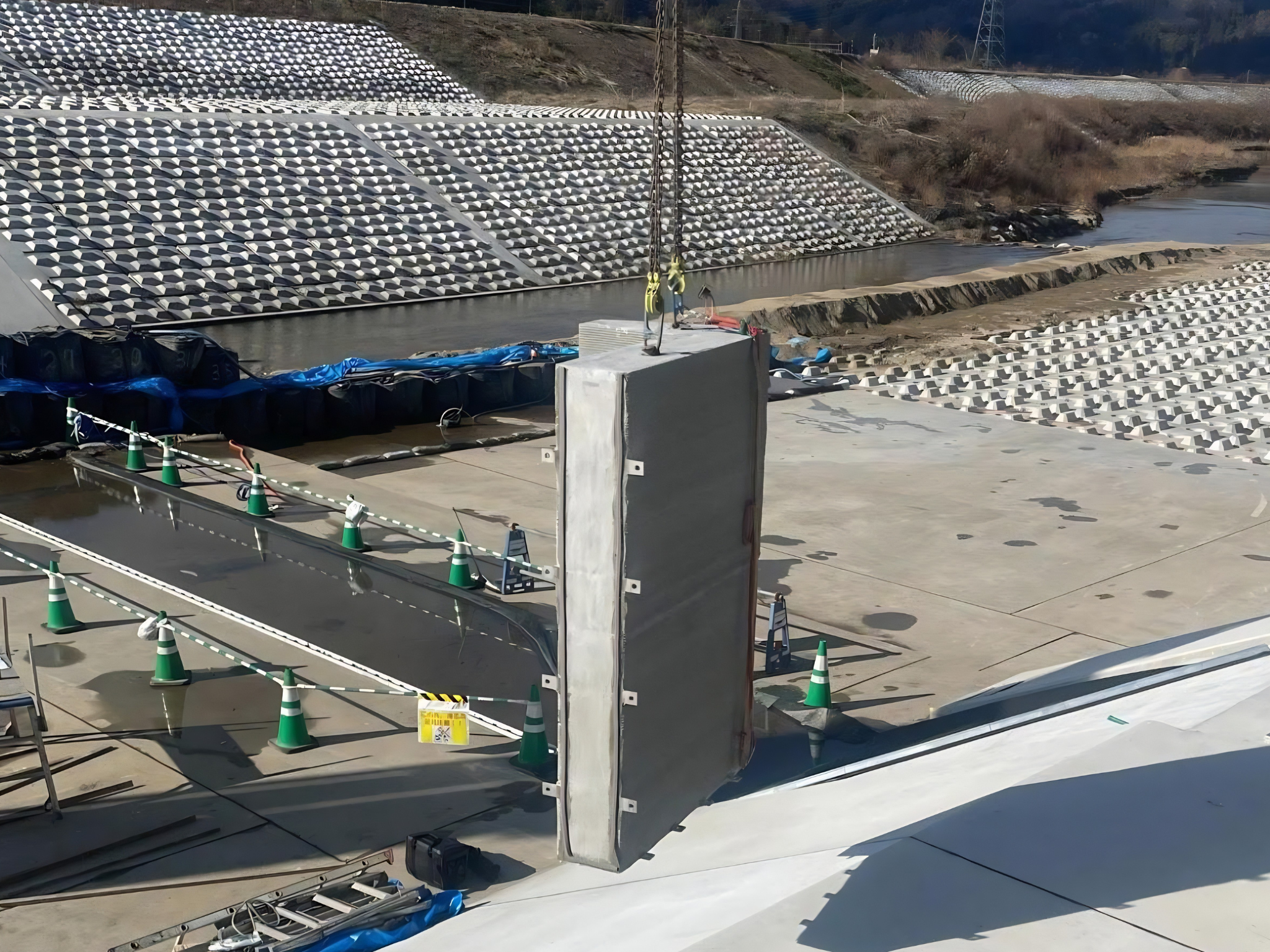
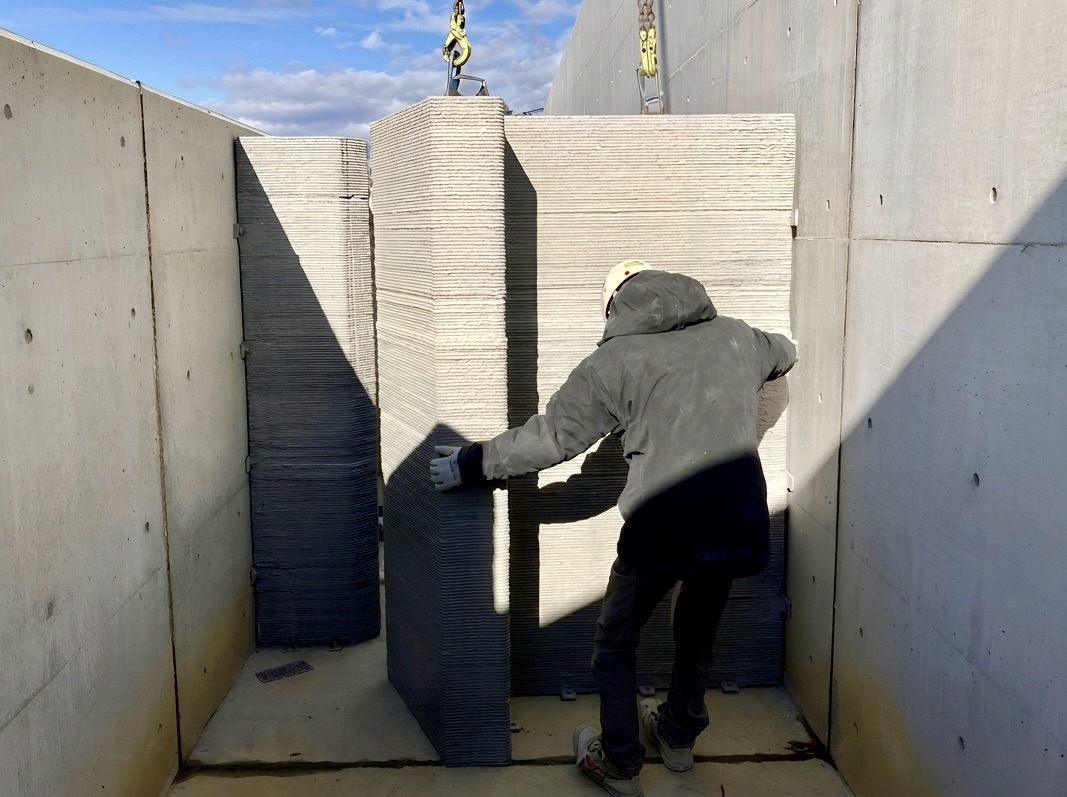
Higashi: At the time, the very idea of “making concrete with a 3D printer” still didn't quite click with the craftsmen. The craftsmen who would install the products on site in particular seemed concerned that structures fabricated with a construction 3D printer would be “hard to handle” because of the unevenness from layering.
In reality, however, the shapes and the placement of the hardware had been designed at the printing stage with construction in mind, making the components easy to lift by crane and easy to install on site, so once they were delivered, the work proceeded smoothly.
40 days cut from the schedule and an eel upstream-migration experiment: results proven with data
—— This was a challenging project that involved carrying out a wide range of verifications within a limited construction period. Looking back on that time, how do you feel?
Aihara: Within the limited construction period of the non-flood season*2, we ultimately achieved major results: “a reduction of 40 working days (−52%) and 40 person-days (−31%).” Getting there, however, took a long series of verifications, one by one, starting with proving safety.
First, to obtain the client's permission to use construction 3D printed structures, we conducted experiments such as proving the strength of the metal fittings to verify that they could withstand the pressure of flowing water. Being able to prove safety objectively with solid experimental data made a truly big difference when explaining things to the client.
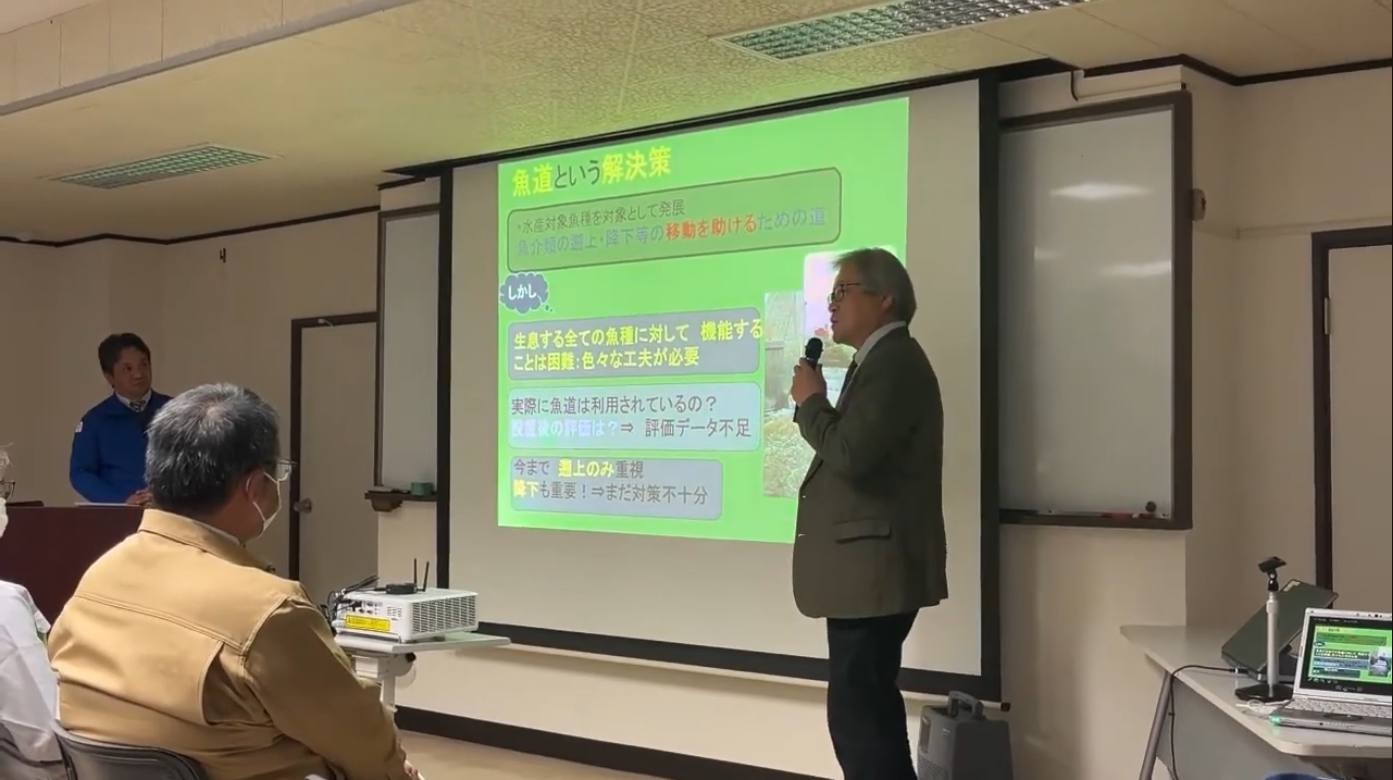
The “upstream-migration experiment with aquatic life” that we carried out in collaboration with Hokuetsu and Hirosaki University was also a great experience. The data demonstrated that, compared with an ordinary smooth concrete surface, the rough surface created by the layering unique to construction 3D printing provides footholds and is extremely helpful for the upstream migration of juvenile fish and small crustaceans such as shrimp, which have weak climbing ability. Being able to contribute not only to technical labor savings but also to the creation of more diverse river ecosystems was a great achievement.
—— Members of our team also took part in the upstream-migration experiment remotely. The moment a fish actually made it all the way up the fish ladder, the whole team erupted in excitement. It left a very strong impression on us.
Higashi: It really did. Being able to obtain these verification results thanks to everyone's cooperation was hugely encouraging.
—— Now that you have actually completed construction with a construction 3D printer, did you achieve the results you had initially hoped for?
Higashi: Yes. Eliminating formwork created an environmental benefit by reducing waste materials on site, and the accuracy of the as-built work (finished dimensions) was better than I had imagined.
Once construction was decided, we also held a site tour at the request of the Tohoku Technical Office, which is responsible for promoting new technologies. The client, the Southern Miyagi Reconstruction Office, also showed very strong interest, saying, “We want to see the actual manufacturing and construction,” and even after the project was finished, many young staff members came to visit.
As for the final evaluation, we fell just short of a particular Director-General's commendation that we had set as an internal goal, so some frustration remains. But the level of attention and the technical results far exceeded the bar we had been aiming for.
Aihara: For my part, I feel it was a great success beyond our expectations. With the cooperation of many stakeholders, it became a truly major project that brought in people both inside and outside the company, and, just as we intended—“if we're going to do it, we want to take on a big challenge that adds value”—I believe we created an excellent use case.
Winning the “Infrastructure DX Award,” and the future Hashimototen is aiming for
—— And you received the Excellence Award in MLIT's “FY2025 Infrastructure DX Award.” Congratulations once again! What was the response inside and outside the company?
Aihara: Thank you. We had pursued this from the outset with the goal of “winning the Infrastructure DX Award,” so we were extremely happy when we won. I feel our technical capabilities and spirit of challenge were publicly recognized on a national level. It has, of course, boosted motivation within the company, and it is also having a very positive effect on recruitment.
Higashi: The client sent us as many as around 30 detailed points to confirm and questions, and each time Polyuse quickly came back with proposed answers and solutions. They came all the way to the site in Miyagi many times to support us. I see this as an award won not by my efforts alone, but through cooperation within the company and together with all of our partners. I would like to turn it into further technical contributions for the company in other ways as well.
—— Has this experience changed your image of “construction 3D printers,” or the way you have worked since?
Aihara: Since this big challenge with the fish ladder, I'm always looking for sites where construction 3D printers can be used, whether in “technical proposals for the next bid” or in “VE proposals after winning a contract.”
Through this experience, I have learned to judge how to make more effective use of construction 3D printers. The question is at which sites, and how, to bring out the unique added value of construction 3D printers: “being able to freely create complex shapes without formwork.” In the next phase, I feel that mastering those “optimal use cases” is where the fun lies, and that it will be the key.
Tsuchida: Being involved in the joint research with Hirosaki University was an extremely valuable experience for me personally as well. Precisely because enthusiasm for BIM/CIM across the industry has cooled down somewhat at the moment, I feel we need a new weapon that adds something extra.
In this construction 3D printer project, there were parts where we could not achieve full end-to-end integration with BIM/CIM data from the design stage, so going forward I want to take on a more advanced form of infrastructure DX: “creating 3D design data matched to existing site conditions in-house, then printing and building it directly with a 3D printer.”
Hashimototen Co., Ltd.
Miyagi
Employees (at interview)
193
Main clients
MLIT, Miyagi Prefecture, Sendai City
Core business
General civil engineering including rivers, roads, sabo and sewerage; building and housing; energy