Toko Sangyo Co., Ltd.
Construction 3D printing turns complex wave-return work into standardized work, cutting construction days and labor by about 80%
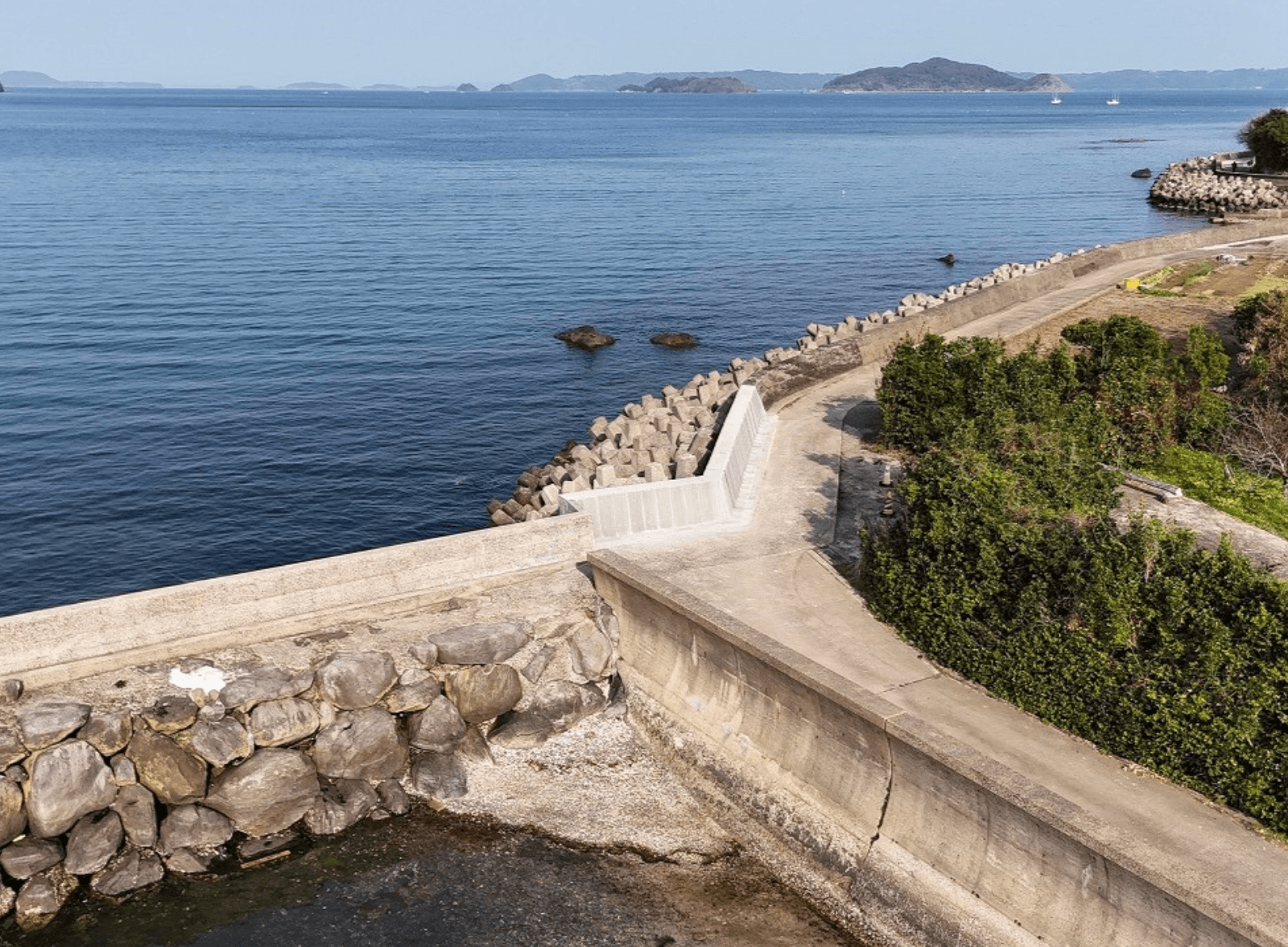
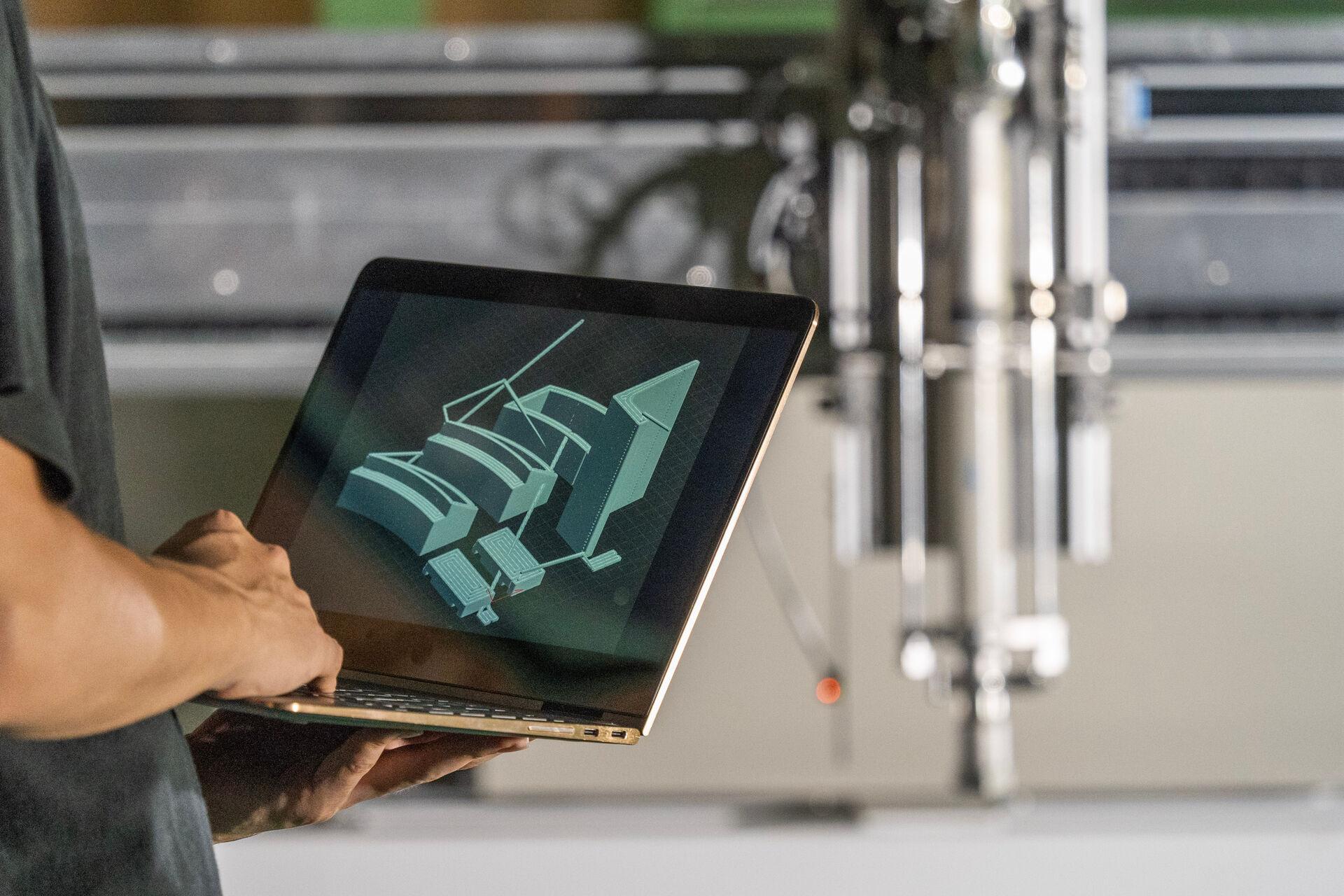
Challenges
- Shortage of skilled formwork workers*1 and soaring costs
No craftsmen in the region could take on the complex formwork for the wave return, and bringing in workers from other prefectures was driving costs up - Two-stage construction due to the recurved shape
Because of the special recurved shape (wave-return cross-section), the structure had to be built in two separate pours: an upper part and a lower part
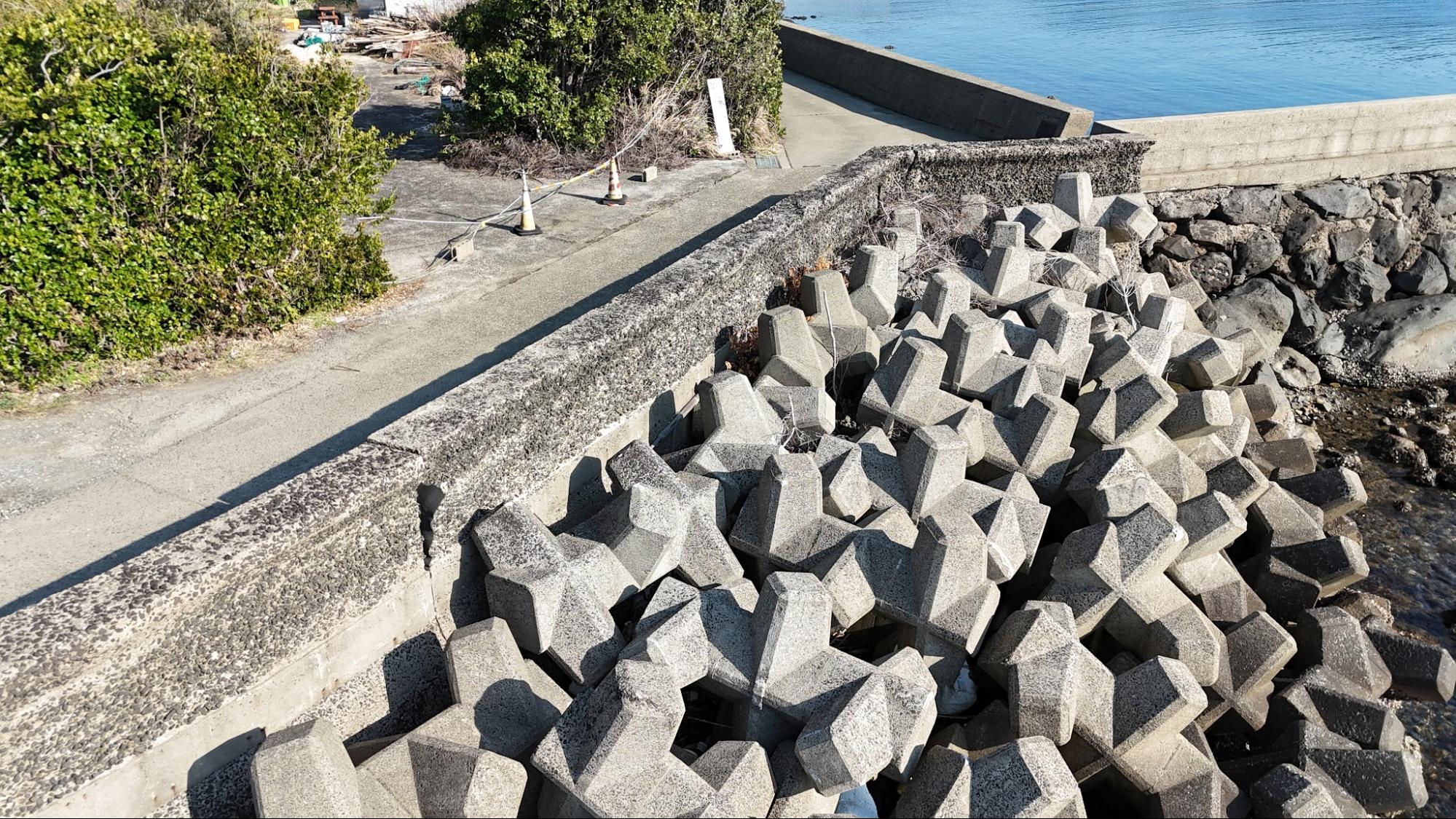
- Temporary removal of wave-dissipating blocks and work on the seaward side
The wave-dissipating blocks installed on the seaward side had to be temporarily removed to make room for assembling and stripping (dismantling) the formwork
- Construction period restricted by the need to avoid stormy seasons
Because construction had to avoid the seasons when the sea is rough, the window in which work was actually possible was severely limited
- Road closures to general traffic
Relocating the wave-dissipating blocks*2 required building a temporary road, which made closing the surrounding roads to general traffic unavoidable
*1: Specialist craftsmen who assemble the formwork (molds) into which concrete is poured and left to harden
*2: Concrete blocks installed to protect coastlines and riverbanks from erosion by waves and flowing water
Results
- A construction setup that needs no formwork carpenters
Completely eliminating on-site formwork assembly and dismantling resolved both the shortage of skilled workers and the soaring costs
- An integrated structure through 3D design
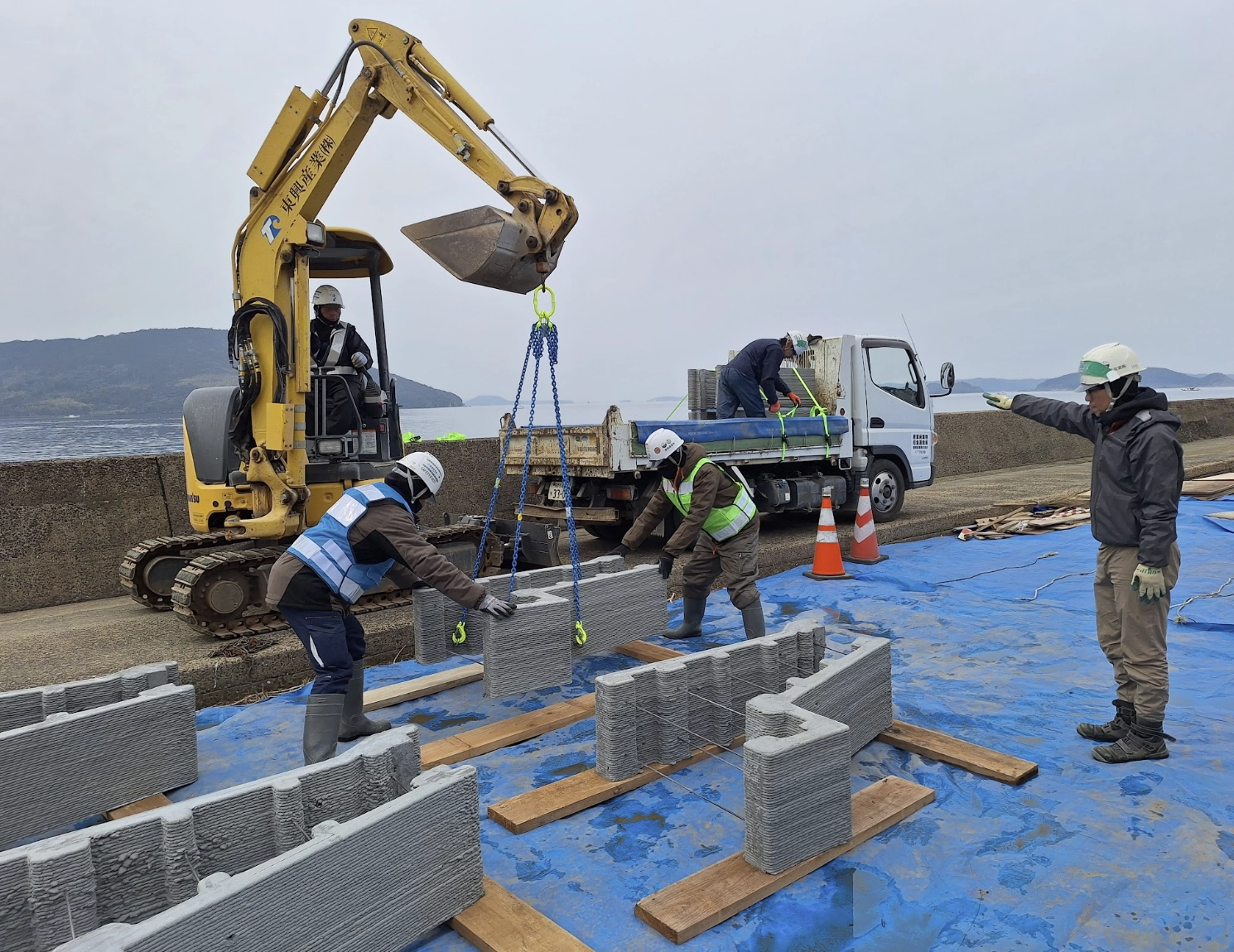
Leveraging the advantages of 3D design, even the special recurved shape could be manufactured as a single integrated piece and installed in one go
- Less seaward work and no need to remove the wave-dissipating blocks
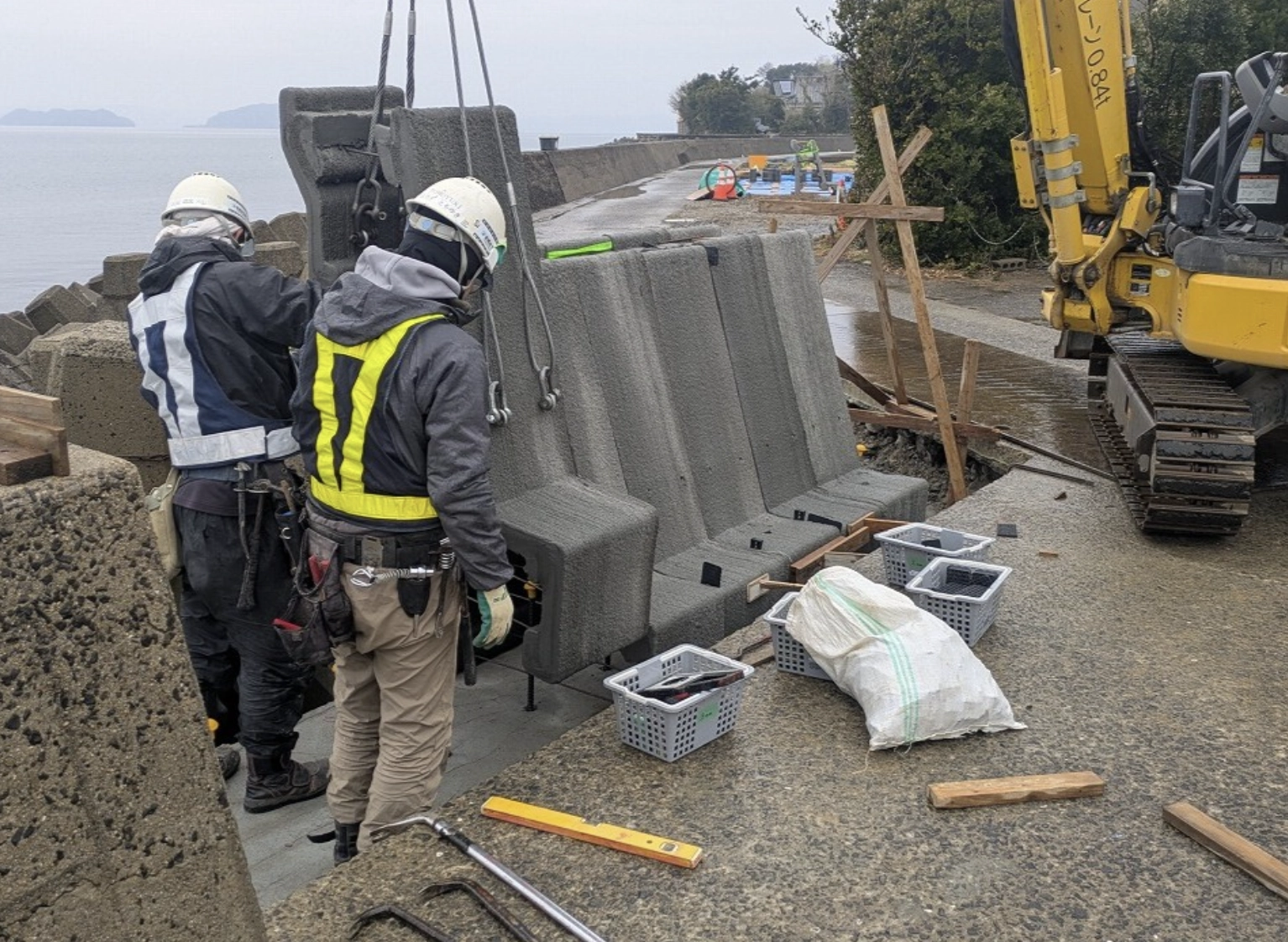
Construction consisted solely of installing construction-3DP components, which reduced work on the seaward side and improved safety. Removing the wave-dissipating blocks also became unnecessary
- Construction 4–5x faster, allowing a schedule with room to spare
Construction days were cut from 23 to 5 (a 78% reduction) and labor from 48 person-days to 13 (a 72% reduction), achieving fast construction within the limited construction period
- Less burden on local residents, with no road closures
Using construction 3DP eliminated the need to move the wave-dissipating blocks, so convenience for nearby residents was maintained without closing roads to vehicles
People featured
 Toko Sangyo Co., Ltd.Managing Director, Civil Engineering Department ManagerKenji Kagawa
Oversees the entire civil engineering division and is engaged in a wide range of work, from site management to cost estimation. A representative project under his management is the site preparation for an industrial park in Matsuura City, which covered a vast construction area and demanded a high level of attention to drainage and the surrounding environment.
 Toko Sangyo Co., Ltd.Construction SupervisorTakanori Maeda
A site manager in his 15th year with the company, leading the actual construction management on the practical side. A representative project is the prefecture-commissioned renovation of aging irrigation ponds (4–5 locations; a large-scale, long-term project spanning about two and a half years), which involved extensive embankment work and was heavily affected by the weather.
This case study features Toko Sangyo Co., Ltd., a company responsible for regional infrastructure development in Nagasaki Prefecture, which used a construction 3D printer (hereafter “construction 3DP”) at a coastal site where construction with conventional methods would have been extremely difficult. We spoke with Kagawa, the company's Civil Engineering Department Manager, and Maeda, its Construction Supervisor, who handled construction management on the project, about the background to using construction 3DP and the specific results it delivered.
The “labor shortage problem” facing the construction industry
—— Please tell us about the structural changes your company has faced in the construction industry in recent years and how you have responded to them.
Maeda: Across the industry as a whole, the chronic labor shortage is becoming increasingly severe. We are currently actively accepting technical intern trainees from overseas (hereafter “foreign workers”).
Kagawa: There are various hurdles in terms of setting up a system to receive them and in management, but given current labor supply and demand, we concluded that employing foreign workers is indispensable and put a system in place to promote it. At present, 5 of the 15 people in our entire Civil Engineering Division are foreign workers, most of them young, aged 25 to 35.
Our Japanese employees, on the other hand, are aging, ranging from their late 40s to their 70s, and this skewed age structure is a challenge. The foreign workers are extremely eager to learn civil engineering skills, and they approached this construction 3DP project with great interest and motivation, seeing it as “a new, advanced technology.”
Maeda: Beyond labor, we also see soaring prices for all kinds of materials, and the resulting rise in design costs, as notable changes in our environment in recent years.
Why construction 3DP was judged effective under highly challenging site conditions
—— What prompted you to consider using construction 3DP?
Kagawa: We had already been gathering information on new technologies and construction methods, and when we observed a footing (foundation) being built with construction 3DP in 2023, we were deeply struck by how rational it was. Many of the sites in our core business areas are at the mercy of the weather, so limiting the risk of construction delays has always been an issue for both bidding and construction. The shorter construction period that construction 3DP brings is an extremely effective solution to this issue, so we wanted to use it.
—— When you actually came to use construction 3DP, how did people on site react?
Maeda: There were expectations of higher productivity, but at first there was also some confusion on the site side. In response to the “formwork-less” concept, concerns were raised about whether we could establish a scheme for structural strength, quality control, and construction management. The craftsmen and operators were also handling construction 3DP structures for the first time, so they were puzzled at first.
We addressed these concerns by explaining that it involves “a quality control process equivalent to that of factory-made precast concrete (secondary products),” which helped build understanding and consensus on site.
—— We understand this site had the harsh environment particular to coastal areas. What specific challenges did you face, and why was the decision made to use construction 3DP?
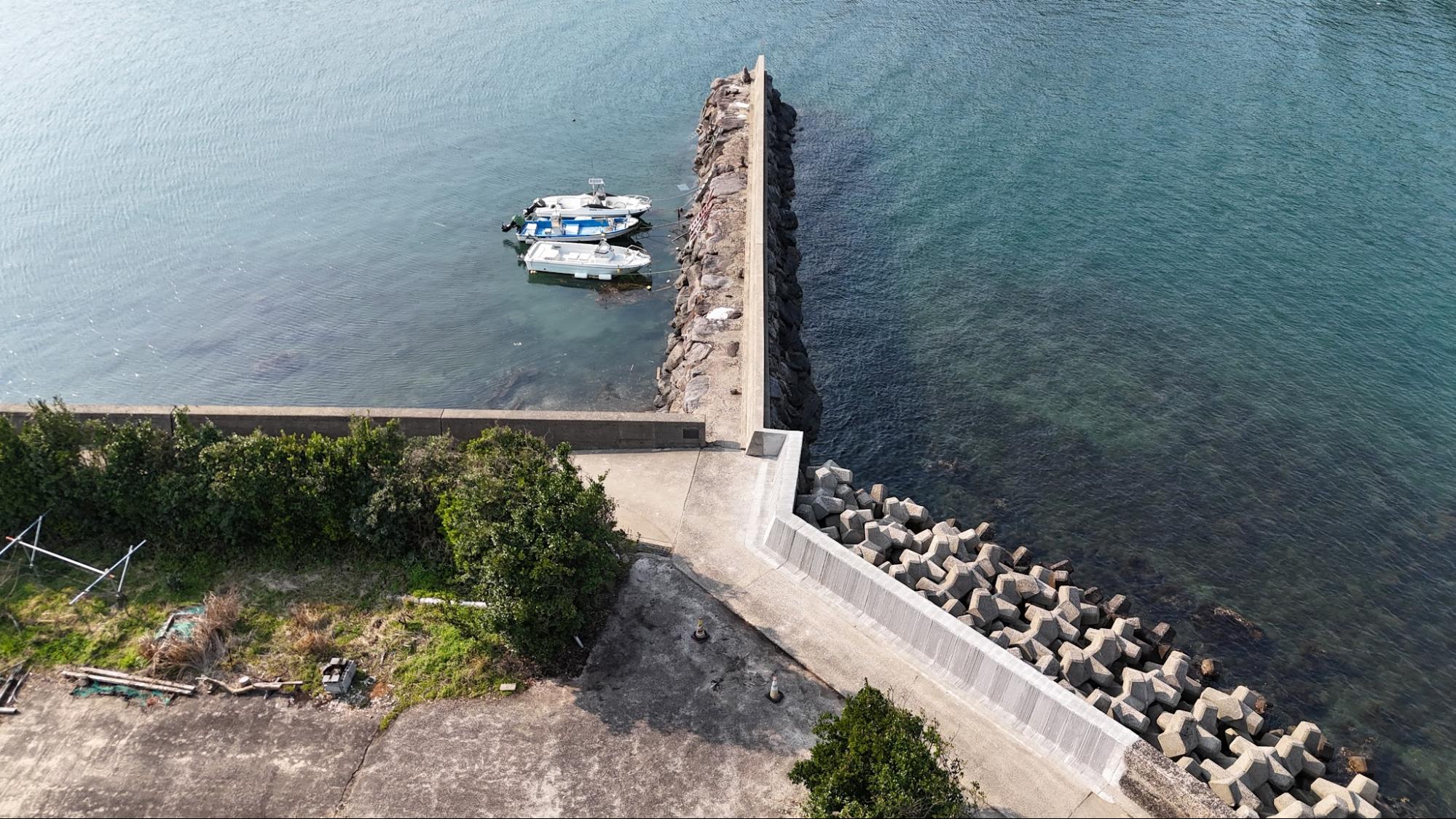
Kagawa: This project involved building a “reinforced wave return”*3 on the very front line of the coast, and every condition made construction extremely difficult.
The biggest concern was the weather and natural risk of never knowing when high waves might strike. With the conventional method (cast-in-place concrete), you assemble formwork on site, pour ready-mixed concrete, and then inevitably need several days of curing until the required strength develops. If high waves came even once during that period, the formwork we had worked so hard to assemble could collapse and be washed away in an instant, so dealing with weather risk was a major obstacle.
There were also serious labor challenges. This structure had a special recurved shape (wave-return cross-section) to deflect waves, and conventionally it would have had to be built in two stages, upper and lower, which was extremely complicated. What's more, there were almost no skilled workers in the surrounding area who could take on complex formwork, so we would have had to secure craftsmen from far away or from other prefectures. Naturally, labor and travel costs would have risen substantially, making budget control and the arrangement of craftsmen extremely difficult.
The existing large wave-dissipating blocks installed on the seaward side of the work area were also a problem. With the conventional method, all of them would have had to be temporarily removed (removed and reinstated) to secure space for the formwork work. On top of that, a temporary road dedicated to heavy machinery would have had to be laid simply to bring in the equipment for relocating the large wave-dissipating blocks, which was expected to entail enormous costs and time.
With the conventional method, we could foresee problems on every front—“weather, labor, and cost”—so we concluded that the only solution was to eliminate on-site formwork work altogether and use construction 3DP, which enables rapid construction.
*3 Reinforced wave return: Work to build a concrete wall (wave return) that prevents strong waves from washing up onto land along coasts and similar locations
Every challenge cleared, with construction days, costs, and the burden on nearby residents greatly reduced
—— What specific construction benefits did you achieve on this coastal project?
Kagawa: The biggest result was that using construction 3DP let us skip the entire process of assembling and dismantling formwork on site. This had an effect on every one of the challenges I just mentioned.
First, because construction speed increased roughly four- to fivefold, we were able to draw up a plan with plenty of room to spare, even within the limited construction period. Specifically, construction that would have taken “23 days” under the conventional plan was shortened to just “5 days” (−78%). This minimized the dangerous time spent exposed to the threat of high waves on site and improved safety.
By taking advantage of the design freedom of construction 3DP, we were also able to manufacture the complex recurved shape—which previously had to be split into two stages—as a single integrally formed piece and install it in one go. On-site formwork work itself became unnecessary, and we no longer had to rely on skilled workers from other prefectures. Because on-site work was greatly simplified and standardized, labor was also reduced from the conventional “48 person-days” to “13 person-days” (−72%), and we achieved safe, consistently high-quality construction even with a team made up mainly of our young employees and less experienced foreign workers.
And by switching to a method in which the construction 3DP components are lifted into place from above, we avoided having to move the wave-dissipating blocks on the seaward side, which had been a concern. As a result, we were able to cut out entirely both the temporary removal of the blocks and the construction of the temporary road that it required.
In terms of contributing to the local community, too, the effect exceeded our expectations. Under the original plan, installing a temporary road to move the wave-dissipating blocks would have forced us to “close the road to general traffic.” However, because using construction 3DP made moving the blocks unnecessary, we completed the work without any traffic restrictions. I'm confident that keeping traffic disruption and noise for nearby residents to a minimum was also a highly valued point from the perspective of the client (the local government).
Standardizing complex, difficult work, with tangible knock-on effects for winning projects and recruitment branding
—— What kind of response has construction 3DP drawn inside and outside the company, and how do you see the prospects for future business development?
Kagawa: Through this actual construction, I have come to feel that even for coastal work such as a difficult reinforced wave return, combining construction 3DP technology in the best way can lower the difficulty of on-site work and standardize it. This reduces our dependence on advanced craftsmanship and creates a setup in which even teams made up mainly of young people and less experienced foreign workers can complete construction safely and with high quality. I believe this will be an enormous management advantage in a construction industry whose labor structure is set to change.
In tenders (such as those using the comprehensive evaluation bidding method), it has also become possible to make “technical proposals for reducing costs and construction periods” that overturn conventional cost estimates and standard construction schemes, and I have a real sense that this gives us a competitive edge when bidding. The recent establishment of a construction 3DP manufacturing base near our area has also been a tailwind: by collecting components directly with our own truck-mounted crane, we have also been able to keep transport costs (freight charges) down.
Furthermore, as a secondary effect, the success of this project is fostering a company-wide “challenge mindset,” including in other departments, which has been a major gain in terms of energizing the organization.
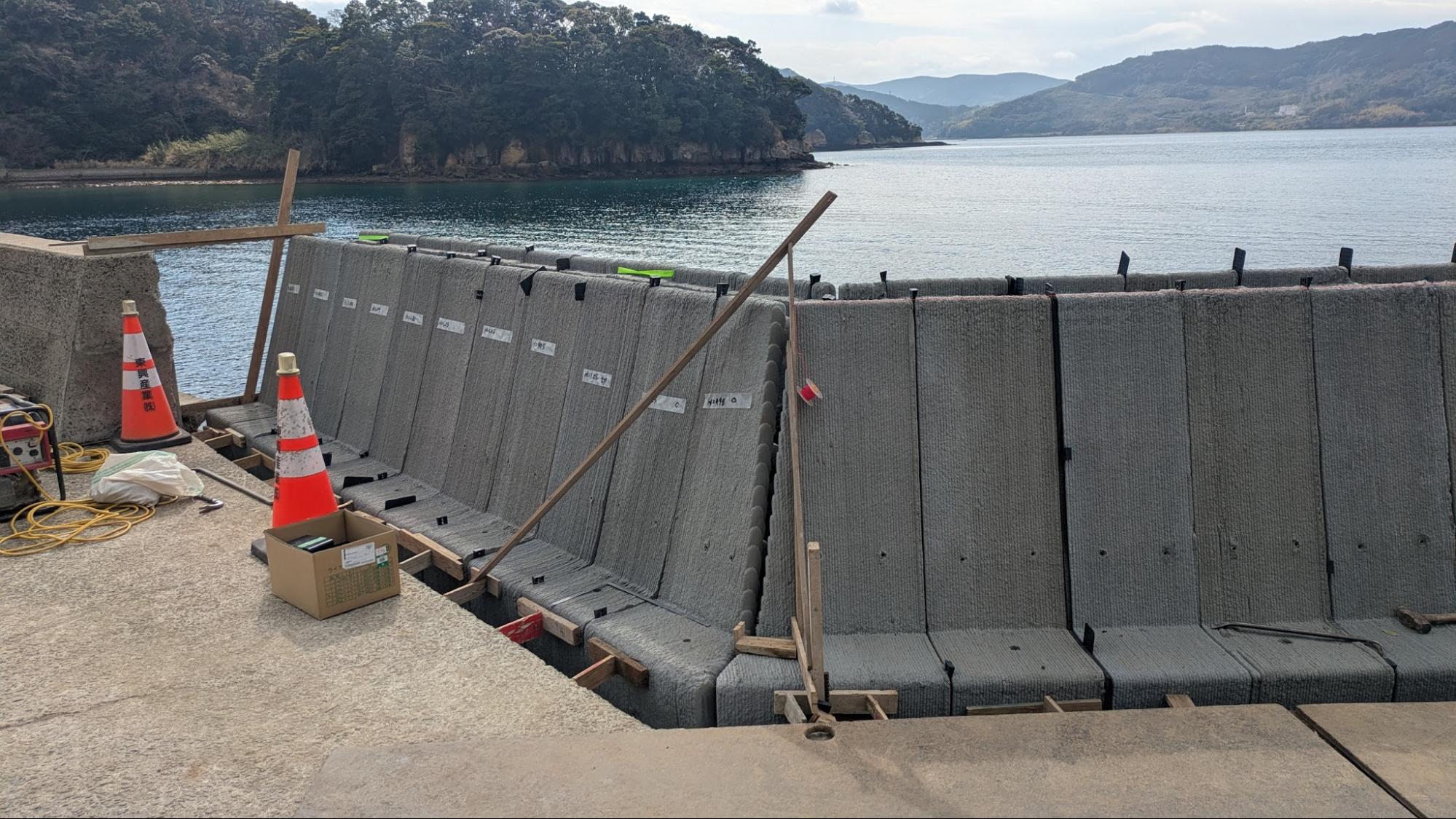
Maeda: On a separate reinforced-concrete project, the construction 3DP components had slits (holes) for the rebar precisely printed in advance, so placing the rebar on site was surprisingly easy. Openings for filling the interior with ready-mixed concrete were also properly provided, so we could reliably confirm the fill visually during pouring. I felt it could be applied right away to sites with tight schedules, such as disaster recovery work.
Construction case studies using construction 3DP are still rare in Nagasaki Prefecture, and indeed across Kyushu as a whole. I feel we are establishing a corporate image as “a contractor that is quick to take on cutting-edge technology.” I expect this to spark interest in joining us among young job seekers who aspire to work in construction, and to become a powerful asset for attracting talent in the future (recruitment branding).
In fact, other companies that have seen this construction track record have already come to us with multiple technical inquiries, creating business opportunities for joint proposals and new projects for work from next fiscal year onward.
A support system that dispels technical concerns
—— How did you find the support from Polyuse, the developer and provider of the construction 3DP?
Kagawa: From the technical consultation stage onward, including front-line support and quick recovery on site, they responded extremely flexibly and quickly. Even though it was our first attempt, we were able to proceed without any technical anxiety. In the regular meetings, too, they were thorough about identifying risks in advance and frequently confirming conditions, which gave us, as the party responsible for construction management, a great sense of reassurance.
Maeda: Construction 3DP is still a technology in its early days and has not yet become fully mainstream across the industry. That is exactly why I would like Polyuse to keep actively sharing its track record, such as construction data from a wide range of site conditions, and to lead the way in raising awareness within the industry.
Toko Sangyo Co., Ltd.
Nagasaki
Employees (at interview)
44
Main clients
Nagasaki Prefecture, Matsuura City
Core business
Reservoir improvement, landslide countermeasures, forestry-related work, etc.