

Kinoshita Construction, which focuses mainly on public civil engineering works in Wakayama Prefecture, has been actively using construction 3D printers*1 since 2022. In 2025, the company brought Polyuse's construction 3D printer, Polyuse One, in-house and opened its own production facility, the "3DP Lab." We spoke with Hiroaki Yamada and Daiki Ietani of Kinoshita Construction, a company that actively embraces new technologies with an eye on the future of the construction industry, about their journey so far and their outlook for the future.
*1 Construction 3D printer: A technology/machine that builds three-dimensional structures by extruding materials such as cement or mortar from a nozzle and stacking them in layers, based on 3D computer data
Challenges
▶Winning more contracts: The company was exploring how to select and introduce new technologies that would earn extra points in comprehensive evaluation bidding
▶The barrier facing small and mid-sized contractors without their own technical departments: Unlike general contractors, the company had no in-house setup for technology development, making collaboration with external partners essential
▶Client understanding: When the initiative began, clients were reluctant to approve construction 3D printing for structures, making it hard to apply in actual construction
▶Attracting young talent: At one time, the company had almost no employees in their 20s or 30s, and recruitment was a management issue
Results
▶Active use of construction 3D printers: In 2024, a design change for stairs was approved through consultation, dramatically shortening a process that would have taken about three weeks with cast-in-place construction
▶Introduction of new technology: Introduced the Polyuse One construction 3D printer in 2025 and opened the "3DP Lab" production facility. Recorded one of the highest operating volumes among the roughly 30 companies that adopted the machine that fiscal year
▶Ripple effects on recruitment: A technical college graduate joined the company after a tour, and four new graduates joined in 2026. The company's image as "a company that takes on new technologies" improved
▶Improved safety: Safer sites through eliminating scaffolding and shortening construction periods
Interviewee Profiles
Hiroaki Yamada, Senior Managing Director and General Manager, Kinoshita Construction Co., Ltd.
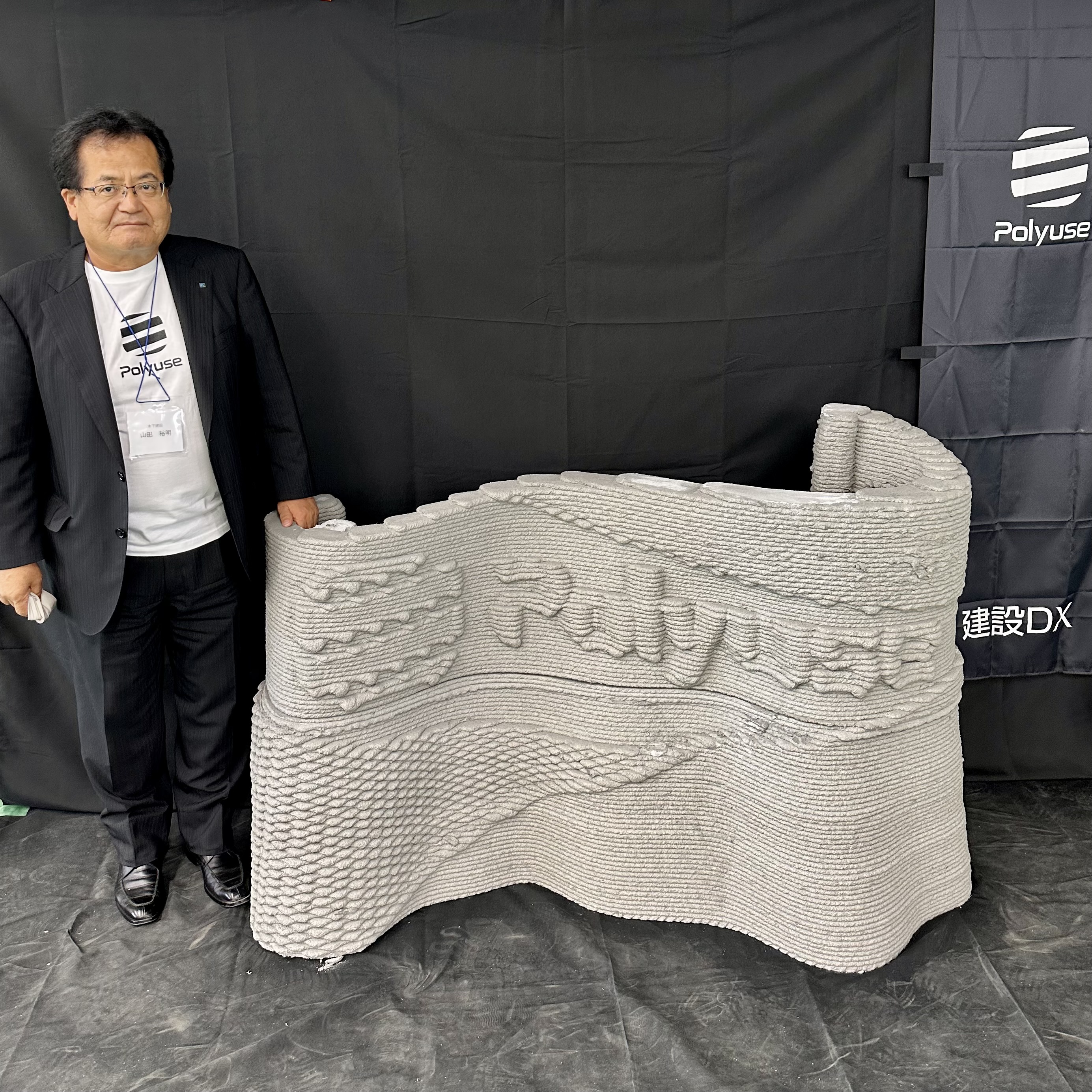
Oversees construction DX across Kinoshita Construction. He is working to raise productivity and save labor at construction sites by improving cost-estimation accuracy and actively introducing new technologies such as ICT, AI and construction 3D printers.
Over seven years, he raised annual productivity per person on prime-contracted works from 70 million yen to 130 million yen. Over the same period, the company won a total of 11 awards, including the i-Construction Award, the Kinki Infrastructure DX Award, the Concrete Structure Contest, and commendations from the Regional Development Bureau Director-General and from MLIT field offices.
Rather than treating "introducing new technology" as an end in itself, he focuses on reducing the burden on people working at construction sites, raising productivity, and making the construction industry more attractive. He is promoting construction DX and the use of new technologies to realize the "new 3K" advocated by MLIT ("good pay, time off, and hope for the future").
Daiki Ietani, Manager, 3DP Lab, Kinoshita Construction Co., Ltd.
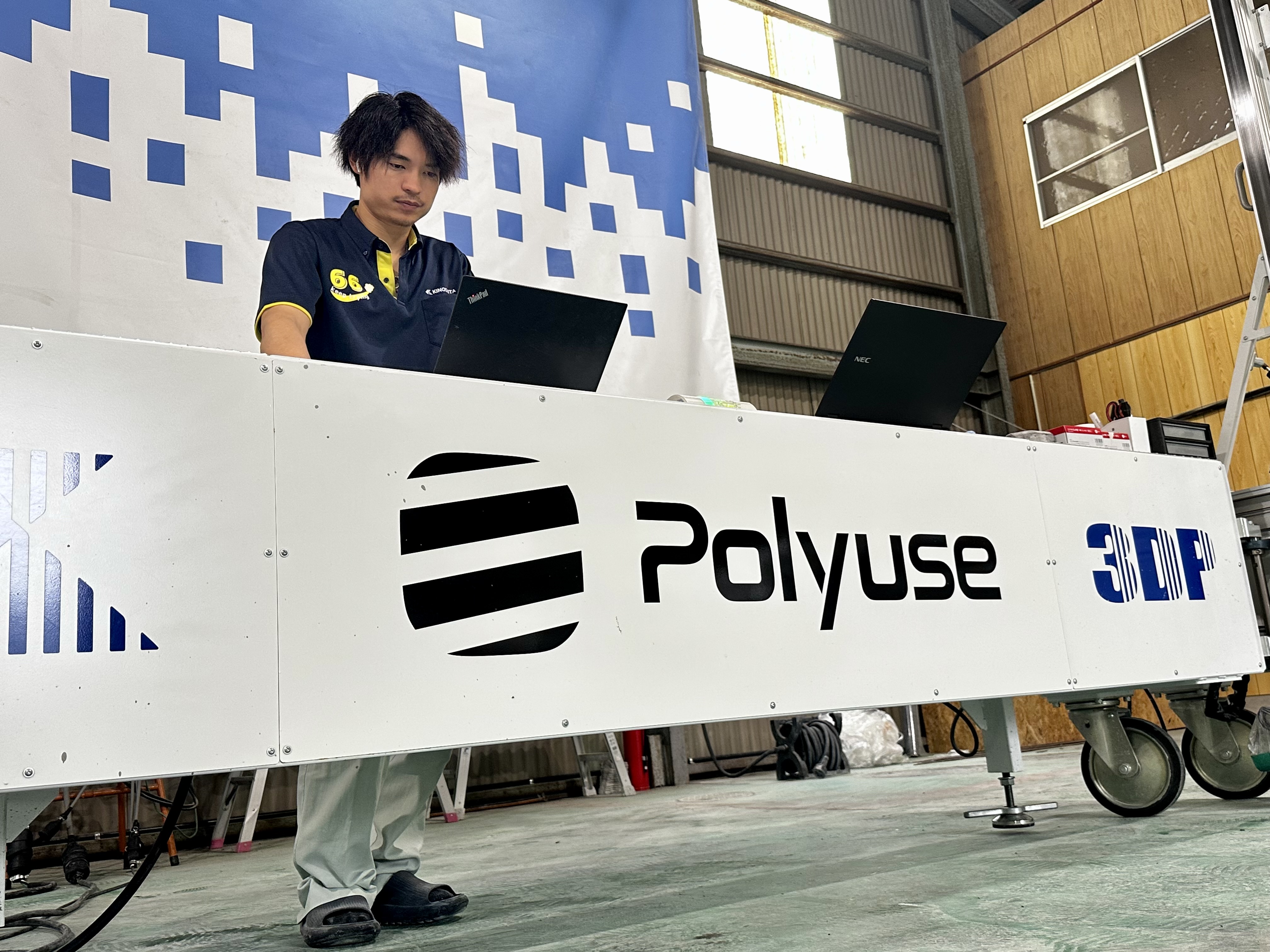
Now in his fifth year at the company, he has worked on bridge repair, ground improvement and more. Appointed to lead the launch of the "3DP Lab," the company's in-house construction 3D printer production facility, he spent a year working on 3D printer technology development. From August this year, he "graduated" from his role as 3DP Lab manager and was posted to a site as the company's youngest site manager. While managing the site, he is also mentoring his successor as 3DP Lab manager (a 21-year-old woman).
"Fall behind the wave of technology and you'll go under": Bringing in new technology through partnerships
— What kind of work do you usually win?
Yamada: Roughly speaking, of our 6 billion yen in sales, 3 billion comes from prime contracts and 3 billion from subcontracts. More than 90% of our prime contracts are MLIT projects, and our subcontracting work is mainly heavy-equipment earthwork for general contractors. With MLIT projects, we can plan our order intake systematically based on construction performance ratings and engineers' scores, so that's what we've specialized in.
Prefectural projects, on the other hand, are awarded mainly on price, which makes it hard to plan a strategy, so how we expand our orders there is a key theme going forward. That's exactly why extra points for our engineers, through awards and the use of new technologies, are so important, and we see construction 3D printers as a weapon for that.
— You've been in the construction industry for about 40 years. How do you see the changes the industry has gone through recently?
Yamada: The technological transformation over the past ten years has been remarkable. The industry is now full of English loanwords, and the evolution of AI (artificial intelligence) is incredible, isn't it? That said, how to use these technologies hasn't been established yet. I think everyone is still feeling their way. At Kinoshita Construction, our mindset is that "if we fall behind the wave of technology, we'll go under." At our size, it's difficult to have our own technical department and do development in-house. That's why we form partnerships with companies that have proprietary technologies, Polyuse among them, and bring those technologies in.
It started with a circular catch basin: Three years spent "raising awareness"
— What first got you interested in construction 3D printers?
Yamada: The main reason was that we were searching for effective new technologies, ahead of other companies, to raise our construction performance ratings even further. We have a track record of being among the first in Wakayama Prefecture to introduce laser surveying and ICT construction machinery. Around that time, I came across Polyuse's work on circular catch basins, and construction 3D printers caught my eye. I contacted them directly through their website, and the first thing we did was go see a sauna construction site in Kochi Prefecture. Back then, nobody really knew how much you could make with a 3D printer, so honestly, my impression was "this looks like it'll be pretty tough" (laughs). But through site tours and other events, I sensed the technology's potential and came to see it as something we could use as a weapon.
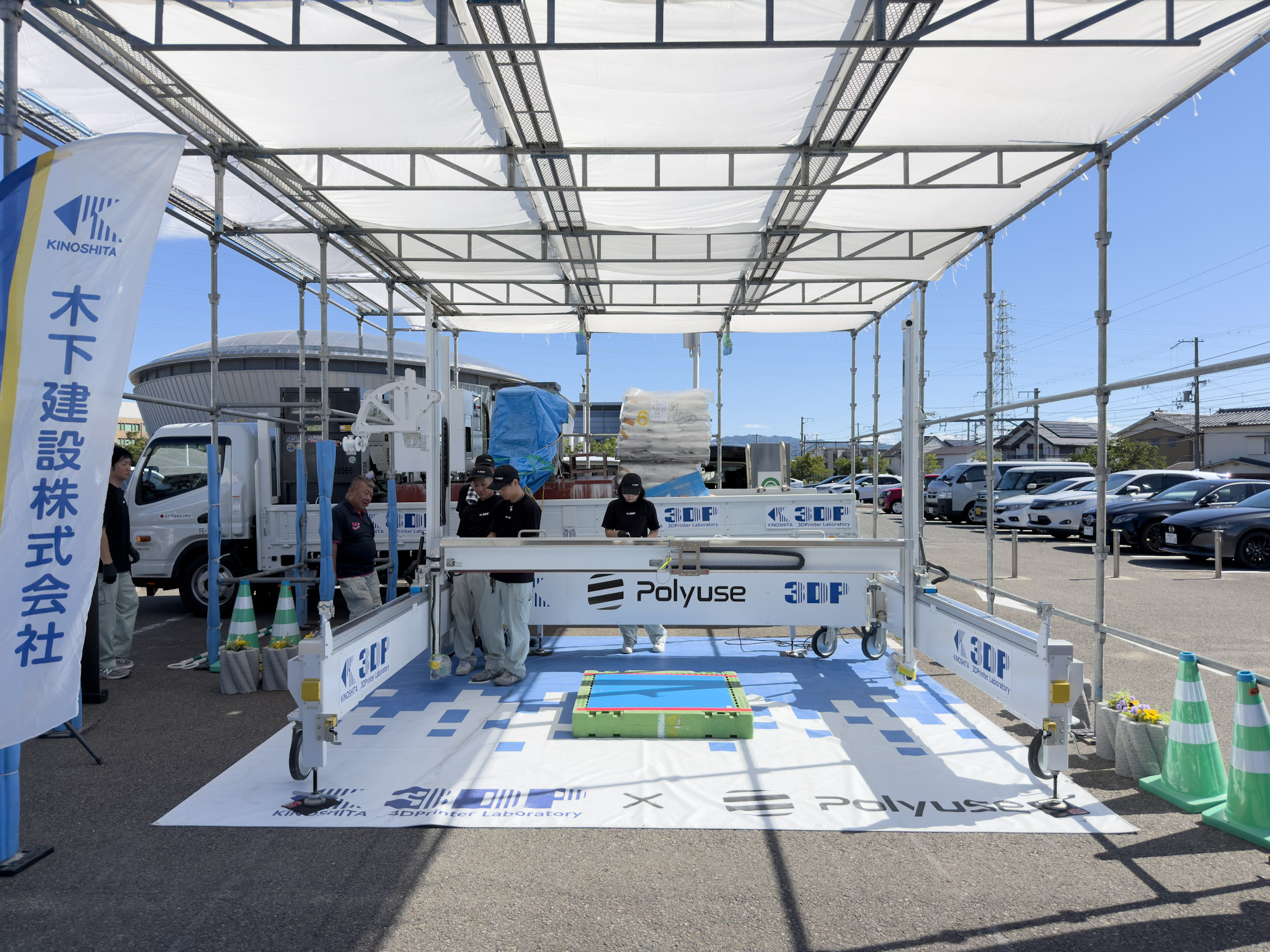
— From 2022 to 2023, you actively pursued initiatives beyond construction applications, such as printing tours and building a concrete canoe. What was your thinking at the time?
Yamada: It was all about raising awareness of construction 3D printers. I remember once telling Polyuse bluntly, "Nobody has heard of construction 3D printers" (laughs). Within the industry, they were still almost unknown. So I figured the only place to start was spreading the word, and we held tours to raise awareness.
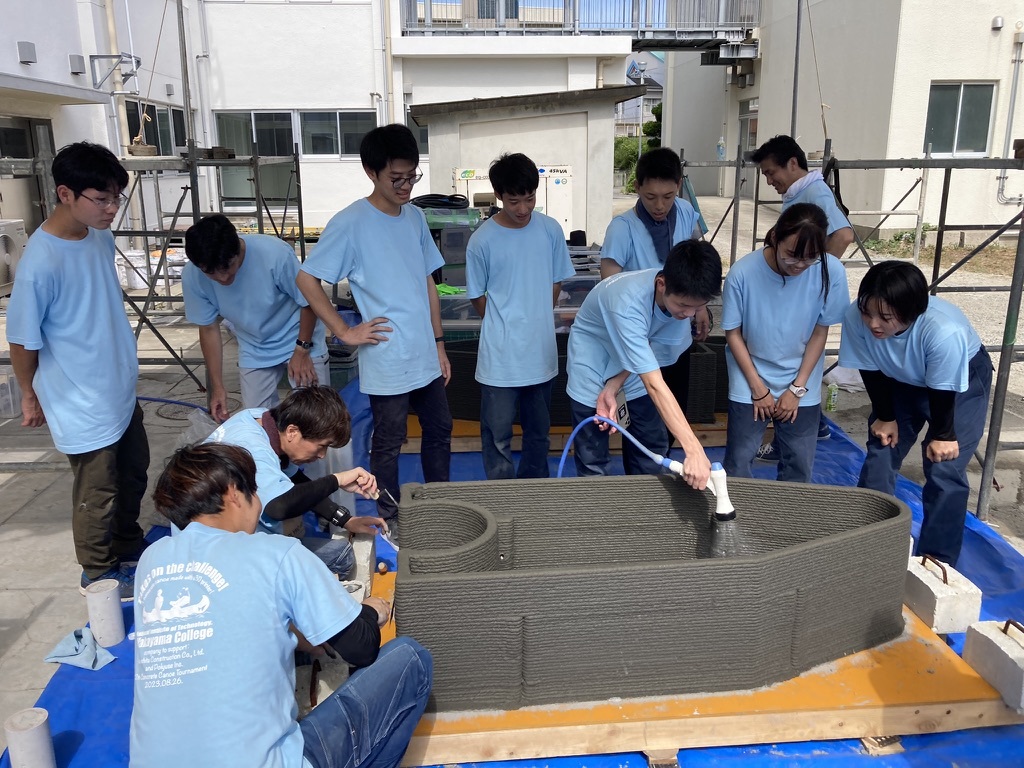
The other aim was to give people the impression that "Kinoshita Construction is an unusual company." Our concrete canoe project with the National Institute of Technology, Wakayama College led to a technical college graduate joining us for the first time in a long while. Four new graduates also joined in 2026, so the impact on recruitment has been significant. I think being known as a company that takes on new technologies, like construction 3D printers and autonomous construction machinery, is helping our recruitment. Tours cost money, but this is one area where they've paid off.
"Get it approved through consultation, not consent": Taking on full-scale construction in 2024
— In 2024, you applied construction 3D printing at scale for the first time, on a gravity retaining wall, widening work and stairs.
Yamada: I felt that if we were going to do it, there was no point unless it made a profit. So I was determined to get it approved not through consent*2 but through consultation*3, no matter what. Of the gravity retaining wall*4, the stairs and the widening work, we managed to get the stairs approved through consultation. Luck played a part, but I consider it a major achievement. The stairs would have taken about three weeks with cast-in-place construction, but using a construction 3D printer shortened that dramatically.
Ietani: I wasn't directly involved yet at that point. It was more that I'd heard "apparently they're doing something like that."
*2 Consent: The act of a contractor requesting a change, such as to the construction method, from the client and obtaining permission. The contractor bears any additional costs.
*3 Consultation: The act of the client and contractor discussing and agreeing on changes to the construction method, specifications, etc. based on the contract documents. Additional costs can be billed to the client based on the agreement.
*4 Gravity retaining wall: A retaining wall with a simple structure that uses no rebar and resists the earth pressure behind it through the weight of the concrete or stone alone
Among the top in operation out of about 30 adopting companies: "It feels like we're developing it together"
— In 2025, you introduced Polyuse One and opened the 3DP Lab. What was the background?
Yamada: It was a strategic decision: if we were going to bring in a machine, we had to keep its utilization rate high. For the reinforced soil wall, we built the use of construction 3D printers into our technical proposal at the bidding stage and won the contract, so it went smoothly. For the footing*5, the client seemed receptive, so we brought it in as a VE proposal*6, and that even led to them saying, "We'd like you to do the columns too." There are still areas where things are hard to push through unless you act strategically, but the atmosphere has definitely become more favorable. On the other hand, there are still times when I feel construction 3D printers aren't very well known.
*5 Footing: The base slab of a foundation at the bottom of a structure such as a column or wall, whose underside, in contact with the ground, is widened horizontally
*6 VE proposal: A technical proposal that a contractor on public works or similar projects makes to the client regarding materials or construction methods that reduce costs, shorten construction periods or improve quality without compromising the function or performance specified in the design documents
— How did the launch go once the machine actually arrived?
Ietani: The first time I saw an actual construction 3D printer was at a tour in 2023. My impression was "this looks pretty tough," but I was also interested. Once it was decided that I'd be in charge, I visited Shomyo Doboku Co., Ltd., which had introduced the machine earlier, to clear up my concerns. I still call them for advice, and I also exchange ideas with Heisei Co., Ltd. (which has also introduced a construction 3D printer) on questions like "How do you run it in an environment where it's hard to get things level?" and "What tools do you need beyond the list of supplied items?"
After we introduced it, I was just giving it everything I had. I'd never done anything like it before, and some things were different from what I'd imagined. But what Senior Managing Director Yamada told me, "It's OK to fail," meant a lot. On a normal site, failure isn't an option. I'm glad I was in an environment where I could take on that challenge.
— In fact, your operating volume in FY2025 was among the highest of the roughly 30 companies (at the time) that introduced the machine that year. Looking back on the year, how do you feel?
Ietani: Construction 3D printing technology is still evolving, so it's fun to be part of that development stage and give feedback. Once, I called a Polyuse developer directly to suggest an improvement to the functions for operating the construction 3D printer, and they said, "That's exactly what we're working on right now," and we got really excited. On the manufacturing side, the first thing we produced, the coping concrete*7 on top of a reinforced soil wall, also needed rebar, so it was very challenging. By comparison, retaining walls have fewer inserts, and they started to feel easy.
*7 Coping concrete: A concrete structure placed or installed at the top edge (crown) of retaining walls, river, port and revetment structures, and the like
— What do you value most in your day-to-day construction work, and how does that connect with construction 3D printers?
Ietani: Safety, above all. With the right construction methods, construction 3D printers can reduce dangerous work on scaffolding, and because they can shorten construction periods dramatically, they can lower the risk of accidents at sites where danger is always close at hand, such as disaster recovery sites. They can also produce complex shapes of any kind efficiently and save time, so I feel it's a technology that goes extremely well with safety.
— What changes has using construction 3D printers brought to your company and your sites?
Yamada: Internally, taking on new technologies has become a selling point for the company, and our corporate image has improved more than we expected. On the site side, though, to be honest, reactions are split. Right now, people are divided between those who are positive and "want to try new technology" and those who "don't want to change the traditional way of doing things." Creating an environment where everyone can take on challenges with a positive attitude is something we need to work on going forward.
Beyond that, I'm always thinking about how to make this properly profitable as a business. If cost performance improves and the "benefits of using it" become clear for sites, the number of people who want to use it should naturally grow.
Toward "a machine anyone can use": Ending reliance on specific individuals is the next theme
— What support do you expect from Polyuse, and what would you like to see going forward?
Yamada: Right now, mastering a construction 3D printer takes a fair amount of skill. I want it to become the kind of machine where, if an employee thinks "I'd like to use it on site today," they can come to the lab, quickly print something and take it with them. If we get to a world where anyone can use it with certification on the level of a forklift course, I'm sure demand for the machine will grow. We plan to have Ietani "graduate" from the lab this August, and we'll train the next person in charge to increase the number of people who can use it. Right now, we're working on manuals that anyone can understand.
Ietani: I don't want it to be a machine that only certain people can operate either. While putting the manuals together, I want to hand things over properly to my successor.
— Finally, please tell us about your outlook for the future.
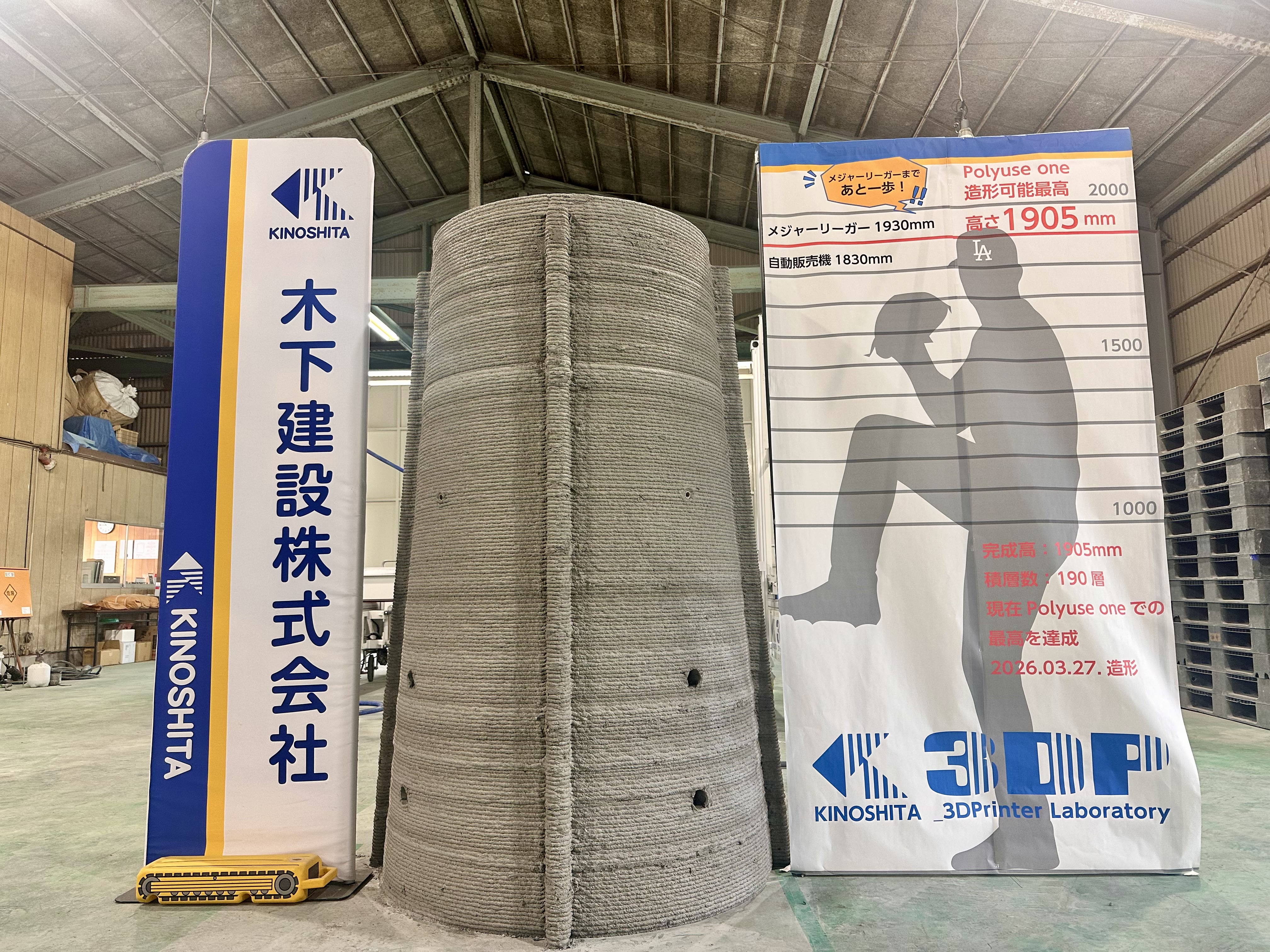
Yamada: I want to register products made with construction 3D printers as Wakayama Prefecture "Kensanpin" construction materials*8, put together a catalog, and create a system that everyone can use. We've also taken on printing in the 1,900 mm-height class, so I'd like to promote ourselves as "the company that built the tallest thing with Polyuse One" (laughs). I've also suggested to Polyuse that they hold a printing contest. If each company enters and competes on quality and design, we can push each other to improve, and I think the level of the whole industry will rise.
Ietani: Right now, Kinoshita Construction is the only company in Wakayama working with construction 3D printers, but I'm thinking about how we'll stand out when another company comes along. The reason is simple: I don't want to lose. I want to go as far as we can. Among the roughly 30 companies that have introduced the machine so far, I want us to be at the top in quality too.
*8 Wakayama Prefecture "Kensanpin" construction materials: A system under which the prefecture registers and publicizes excellent construction materials, new construction methods, environmental technologies and the like produced or processed within the prefecture, with the aim of revitalizing local industry and ensuring the quality of public works
◼︎About Kinoshita Construction Co., Ltd.
Company name: Kinoshita Construction Co., Ltd.
Founded / Established: 1957
Employees: 64
Main business: Public civil engineering works (river and road structures, bridge repair, heavy-equipment earthwork, etc.)
Service area: Wakayama Prefecture
URL: https://www.kinosita-kensetu.co.jp